Search

Thursday, December 9, 2010

ACLU Tells Horror Story of Immigrant Imprisonment in West Texas


Pecos Prison Burns/Photo by Tom Barry
Last year, a year after the immigrant inmates at the Reeves County Detention Center in Pecos, Texas rioted, the ACLU of Texas and Austin-based Grassroots Leadership, sponsored a protest march and vigil to bring attention to the prison conditions.


The march from the Reeves County Courthouse to the 3,750-bed prison on the outskirts of this remote West Texas town was ignored by all but a few media outlets. At the vigil outside the prison, family members of inmates of the prison operated by the corrections giant GEO recounted stories of medical neglect and abusive treatment suffered by sons and brothers.


The twenty or more protesters were all outsiders – most of whom had traveled a couple hundred miles to express their concern and solidarity. In Pecos, the prison is the main source of jobs. Reeves County, which built the detention facility in 1988, regards the prison as a major source of revenue. Any criticism of the prison in Pecos is considered an existential threat.


If the prison were to close, more than four hundreds of jobs would dry up, the county government would be left bankrupt, and the county's 31% poverty rate would climb.


Pecos, the county seat, is already a sad, forlorn place. Since the late 1940s it has suffered from a succession of economic busts, starting with the army's bomber training base closing. As the water table dropped, the cotton farms and mills shut down. In the 1990s, the sulfur mine on the county's western edge closed, and the food processing plant in Pecos moved operations to Mexico.


The oil wells around Pecos stand still. The railroad, which put the town on the map in the late 1880s, still runs through town, and at night you can still hear the whistle blow. But the train doesn't stop in Pecos anymore.


In the mid-1980s the county government invested in prison industry. Using project revenue bonds, it expanded the county jail and began renting bed space to state government and the feds. Since 1988 the detention center has undergone three major expansions, all financed by tax-exempt revenue bonds the county offered to major investment houses.


Vigil outside Pecos Prison/Tom Barry
The county still owns the prison, and it has more than $120 million in outstanding prison debt. While the Reeves County Detention Center – a sprawling complex of three units – is still public property, it is operated through contracts and subcontracts with private partners.


Through what are known as Criminal Alien Requirement (CAR) contracts, the Bureau of Prison – an agency of the U.S. Department of Justice -- contracts the county to house and care for immigrants who have been criminally charged and sentenced. The county subcontracts with GEO Group to operate and manage the immigrant prison and with Physicians Network Association (PNA) to provide health care to the immigrant inmates.


Pecos now faces another economic threat.


It's not that the flow of immigrant inmates is drying up. New policies at the Department of Homeland Security that criminalize illegally entry into the United States have flooded federal courts with immigrant prosecutions, and BOP has since 2001 issued CARs to private prison firms and local governments like Reeves County for immigrant imprisonment.


Once completing their sentences, generally under five years, immigrant inmates are transferred from BOP-supervised prisons to detention centers supervised by the Immigration and Customs Enforcement (ICE), a DHS agency that process the immigrants for deportation. These detention centers are generally operated by private prisons firms like GEO. For each of the past seven years, ICE has reported record highs in the number of immigrants detained and removed – with approximately 290,000 in 2009.


The problem, then, is not that Pecos is facing a shrinking market of prisoners to lock up for pay. The problem is a dead immigrant, Jesus Manuel Galindo, who died in isolation from an epileptic seizure at the Pecos prison on December 12, 2008.


His death set off two prison riots – one that erupted the day his body was discovered, and one a month later. The damage caused by the riots obligated the county to issue $40 million in new revenue bonds to pay for the prison renovation to meet BOP standards. At the county meetings following the prison disturbances, the commissioners and county administrators expressed no concern about prison conditions. The concern was how much it was going to cost the county.


Now comes a new threat to the economic stability in Reeves County.


The ACLU of Texas together with an El Paso private law firm has filed a massive law suit on the behalf of Galindo's family against Reeves County. Also named in the wrongful death lawsuit are BOP, GEO, and PNA, as well as individuals at each of these entities. The complaint, filed in West Texas district court in Pecos, states: "All four entities involved in Mr. Galindo's custody and care—PNA, GEO, Reeves County, and BOP—bear legal and moral responsibility for his utterly preventable death."


Recounting the immigrant inmate's final days, the law suit states:


"Galindo had been held in solitary confinement for one month before he died as punishment for complaining that his seizure medication was not working. He suffered at least two seizures while in isolation during that month, and repeatedly asked medical and prison staff to adjust his medication and move him out of solitary so that he would not be alone when he seized. Galindo ultimately suffered a fatal seizure during the night and died alone, unattended and undermedicated—exactly as he feared he would in the anguished days and weeks preceding his death. RCDC prison and medical staff discovered his body the following morning in rigor mortis."

 
Galindo is survived by four minor children, three of whom are U.S. citizens, and by his parents and two siblings, all legal permanent residents living in Anthony, New Mexico. A Mexican national from Juárez, Galindo was serving a 30-month sentence for illegal reentry -- which, as the law suit notes, is a nonviolent crime that until a few years ago was not aggressively prosecuted."


Media reports, including major investigative pieces published by the Boston Review and the Texas Observer, attacked some public attention to the poor conditions and the related economic underpinnings of immigrant imprisonment.


But the new legal complaint, which includes a detailed chronology of Galindo's mistreatment and suffering at the hands of the four-way prison partnership, must have Galindo's jailors frantically consulting with their respective lawyers about how much this will cost them.


It seems certain that the lawsuit will result in either a massive settlement or court award. The plaintiffs are demanding a jury trial on ten claims for action. As the legal complaint, which was filed in Pecos on December 7, makes clear, the responsibility for Galindo's horrible death rests not only with the four prison partners – Reeves County, GEO, PNA, and BOP – but also with the system of immigrant prison outsourcing.


The 92-page complaint is modern American horror story. According to the plaintiffs, "The utter disregard shown by RCDC, prison and medical staff to Galindo's repeated, beseeching, well-founded expressions of fear for his own personal safety bordered on sadistic."


No one person killed Jesus Manuel Galindo.


He was tortured to death by the bureaucracy of immigration enforcement, by the drive for profits, by a criminal justice system that criminalizes and victimizes immigrants -- and by a small West Texas town trying to survive.


(Next: The Chronology of a Death in Texas)

Wednesday, December 8, 2010

Mexico's Failed State: Yes, No, or Maybe Soon


Recruiting billboard for police in Juárez

The traits of a failing state – loss of control over national territory, inability to provide public services, loss of monopoly on legitimate use of violence or physical force, and widespread corruption and criminality – are increasingly recognizable in many areas in Mexico. This is the case not just along the northern border – from Baja California to Tamaulipas – but also in such states as Guerrero, Durango, and Sinaloa.


It would certainly be inaccurate, at this point, to describe Mexico a failed state. Yet a serious discussion about the degree to which the Mexican state controls national territory, protects its citizens, and ensures governance is not premature.


The questionable legitimacy of the 2006 election that put him in Los Pinos may have been a factor in the decision by President Felipe Calderón to launch the war on drugs. His launching of the war on drugs burnished Calderón’s credentials as a strong leader and tough national security chief, much like Colombia’s Alvaro Uribe.


But political opportunism alone doesn’t adequately explain Calderón’s decision to launch the war on drugs and join a security alliance with the United States. On becoming president in 2006, it is likely that Calderón understood that Mexico was for the first time facing an existential threat in the form of narco-violence and the penetration of organized crime organizations.


As the date for the 2012 presidential election presses closer and as the failure of the Mexico’s drug war deepens, Mexico’s future is on the line.


But the options for stabilizing and securing the Mexican state are limited.


Political Parties on the Sidelines


On both the left and the right, Mexico’s political parties have little to offer in the way of a serious reform agenda.


The conservative National Action Party (PAN)’s traditional vision of a rule-of-law, citizen rights, free enterprise, corruption-fighting, and morality-centered government no longer inspires as it once did. After nearly two-decades in various positions of municipal, state, and federal power, PAN’s identity as a white knight coming to rescue the state from PRI domination and a corrupt, increasingly dysfunctional system no longer resonates.


Similarly, the Party of the Democratic Revolution (PRD) and other left parties suffer from their collective history of infighting, their practice of spouting of tired leftist dogma, and their lack of achievements.


Poised for a major political comeback in the 2012 presidential election, Institutional Revolutionary Party (PRI), which has been out of power since 2000, seeks to tap anti-incumbent voter sentiment and nostalgia for a PRI-dominated era remembered by many as being more stable and secure, and even more prosperous.


When compared with the political and governing practices of the last century, Mexico’s political scene may seem refreshing dynamic and transparent. There are now multi-party elections and unprecedented electoral transparency.


Nonetheless, there is a deepening sense that Mexico is stagnating politically, and even seems to be moving backward.


The PRI, which holds 19 of the country’s governor seats, is also the dominant force in Congress, holding 237 seats, with PAN occupying 146 and PRD having just 71. Not only is PRI forwarding a presidential candidate who is nationally well-known and well-regarded – Mexico state governor Enrique Peña Nieto – but it will also embark on its presidential campaign with an appealing anti-incumbent message.


What is more, the PAN-PRD coalition (which obstructed PRI’s plan to make a clean sweep of the 2010 gubernatorial races) will not be an obstacle in the presidential election, since neither the PAN nor PRD is likely to agree on a common candidate given their sharply different political views and party platforms.


Although PRI will take full advantage of anti-incumbent voter sentiment, the party holds out little hope that it will champion a reform agenda to tackle the country’s severe problems.


Drug trafficking organizations did once find a profitable place within PRI’s corporatist structures. However, the old structure of a few geographically based and tightly controlled drug-trafficking organizations has given way to array of new organizations that are all over the map.


No longer do the narcotics trafficking organizations seek control only of the trafficking routes into the U.S. market. They and their subsidiaries also ferociously compete for control of the rapidly expanding domestic drug markets, mainly for crack cocaine and methamphetamines.


The most ominous difference, however, is that the old drug trafficking organizations are now diversified operations. They have become mafias or organized crime organizations, whose interests include a wide array of illegal and legal businesses.


Politicians and parties are no longer the overlords that establish the terms of the deals under which drug cartels operate in Mexico. Instead, they are regarded as the pawns, puppets, and instruments of the new crime organizations.


Rethinking Mexico


It is no wonder, then, that the United States is reevaluating its security threat assessment of Mexico.  


In a September 2010 speech at the Council on Foreign Relations in Washington, Secretary Hillary Clinton shocked many with her frank assessment of the gravity of Mexico’s security crisis and her consideration of a more ambitious plan to contest the power of organized crime.


"We face an increasing threat from a well-organized network, drug-trafficking threat that is, in some cases, morphing into, or making common cause with, what we would consider an insurgency," Clinton said. While both the Bush and Obama administrations endeavored to sharply differentiate the Merida Initiative from Plan Colombia, Secretary Clinton explicitly compared the present crisis in Mexico to Colombia’s campaign in the 1990s against that country’s narcos and its narco-financed leftist guerrilla insurgency.
Clinton raised the possibility that the United States, Mexico, and the Central America nations may all need to cooperate in an “equivalent” to Plan Colombia, the multibillion dollar campaign of military aid and counternarcotics assistance launched during the Clinton Administration.
It is widely accepted that Plan Colombia did help eliminate the dominant drug cartels and significantly weaken the leftist insurgencies, albeit with a less successful records in obstructing cocaine flows or diminishing human rights abuses by the military and right-wing militias. Plan Colombia, which gradually merged the fight against narcotrafficking and the leftist guerilla army FARC, has been widely criticized for sparking increased human rights violations and for bolstering military impunity.
According to Clinton, "[I]t's going to take a combination of improved institutional capacity and better law enforcement and, where appropriate, military support for that law enforcement... to prevent this from spreading and beat it back." Clinton maintained that Plan Colombia “worked” and added, “We need to figure out what are the equivalents for Central America, Mexico and the Caribbean.
Clinton’s statement signaled that Washington was increasingly considering the power and violence of Mexico’s crime organizations not simply as a drug war concern but as an existential threat to Mexico.
The problem is that there is no apparent plan – either coming from Mexico or Washington, or jointly – about how to best confront the power of the Mexican-based organized crime organizations.
The United States has no apparent interest or appetite for direct intervention, even if requested by Mexico – as improbable as that may be. It’s highly unlikely that the U.S. Congress, especially one where the House is controlled by Mexican-bashing Republicans, would accede to any administration request for vastly increased military and other spending in Mexico, along the lines of another multi-billion dollar Plan Colombia.
 As the State Department cables indicate, there is deepening concern among U.S. officials that its Mexican partners are not sufficiently modernized, united, or committed to waging an effective campaign against the country’s organized crime forces – a fight that would necessarily also entail a frontal assault on official corruption and impunity.
It does appear – in the evolving official assessments of drug war, op-eds in Mexico City papers, and elsewhere – that the Mexican government, business community, and citizenry are slowly beginning to acknowledge that this crisis is about much more than widespread delinquency and inter-cartel violence.  Territory is being lost, politicians are being killed and kidnapped, and the power balance between the state and organized crime may be shifting in favor of the syndicates.
The country’s political parties, however, are narrowly focused on short-term political gains. In the country’s center of power and population – Mexico City – the crisis is still largely regarded as one limited to distant regions deemed of only marginal relationship to the economic and political course of the country.  
The reflexive blaming among many Mexican sectors of the United States for the spread of narco-violence and organized crime also militates against any honest evaluation of the stability and viability of the Mexican state.
The debate over whether Mexico is deteriorating into a failed state is a fascinating one. But it may distract from the pressing challenge of formulating new social and political options for staunching the rise and the territorial ambitions of organized crime in Mexico.

Tuesday, December 7, 2010

War on Drugs Has Mexico Running Scared


In December 2006, newly elected Mexican president Felipe Calderón donned military fatigues and declared a “war on drugs.” Washington, increasingly concerned about the steadily rising power of Mexico’s drug cartels, expressed its strong support for the Mexican president’s decision to deploy the Mexican military in this domestic war.


At President Bush’s behest, the U.S. Congress in 2008 approved the Merida Initiative, which authorized $1.3 billion on military assistance and other U.S. aid to Mexico (and to a lesser extent Central America) to fight the drug war and organized crime over three years.


Calderón’s decision to tap SEDENA – the National Defense Secretary – to direct the campaign against the drug trafficking organizations was never questioned by Washington policymakers. Even after two years of dubious accomplishments in army-led war on drugs, the new administration of Barack Obama opted to continue Washington’s whole-hearted support for Mexico’s war.


In the administration’s first year, DHS Secretary Napolitano, Drug Czar R. Gil Kerlikowske, FBI Director Robert Mueller, Counterterrorism Advisor John Brennan, and Secretary of State Hillary Clinton uniformly praised Calderón’s “courage” in taking on the cartels. The administration also continued its predecessor’s strong backing of the Merida Initiative.


The near-giddy enthusiasm at that time for Calderón and his declared war on drugs has given way more recently to a more sober evaluation of drug war, the role of the army, and binational cooperation.


By late 2009 the spectacular failure of the army’s offensive against the cartels – so evident in the disaster of “Operación Conjunto” in Chihuahua – obligated administration officials to tone down their acclaim for Mexico’s drug war.


WikiLeaks Revelations


The degree of the deepening frustration with its partner institutions in Mexico and the spreading gloom about the prospects for stability in Mexico came to light recently in the secret State Department cables released by WikiLeaks.


In marked contrast to the shine given to U.S.-Mexico cooperation in the four-year drug war in Mexico by U.S. officials, the diplomatic cables have revealed a more sober assessment of the relationship, the war’s progress, the capabilities of its Mexican partners, and of the Merida Initiative framework of cooperation.

After dining with Mexico’s then-Undersecretary of Interior Geronimo Guitierrez and U.S. Justice Department officials, one U.S. diplomat reported that Mexican officials had belatedly realized that the initiative was patched together with “not enough strategic thought” and with “too much emphasis in the initial planning on equipment.” An October 2009 cable reported that Gutierrez “expressed a real concern with ‘losing’ certain regions” of the country to the drug cartels. 

In a Nov. 9, 2009 cable, U.S. Ambassador Carlos Pascual wrote: "Mexico's use of strategic and tactical intelligence is often fractured, ad hoc, and heavily reliant on the United States for leads and operations." He lamented the “entrenched mistrust” and turf wars that obstructed collaboration among the various security forces in Mexico. They "would rather hoard intelligence than allow a rival agency to succeed."

The cables also point to the Mexican Army’s lack of modernization, its risk-avoidance, and its inability to adapt to its law enforcement mission.
Perhaps the most embarrassing assessment about Calderón’s drug war strategy came in cable communication that praised the cooperation and operations of the Mexican Navy (SEMAR), which operates apart from the SEDENA and the Mexican Army.

One cable noted that SEMAR “has shown itself capable of responding quickly to actionable intelligence. Its success [in hunting down drug kingpin Arturo Beltrán Leyba] puts the Army … in the difficult position of explaining why it has been reluctant to act on good intelligence and conduct operations against high-level targets.” 

The Dec. 17, 2009 cable stated, “The U.S. interagency originally provided the information [about Beltrán Leyba’s whereabouts] to SEDENA, whose refusal to move quickly reflected a risk aversion that cost the institution a major counternarcotics victory.”

Despite U.S. commitment’s to assist in the modernization of Mexico’s judicial system, the State Department communications bemoan the country’s low prosecution rates. According to one cable, “Prosecution rates for organized crime-related offenses are dismal, 2 percent of those detained are brought to trial. Only 2 percent of those arrested in Ciudad Juarez have even been charged with a crime.”

In an apparent reference to corruption in Mexico’s security forces, a WikiLeaks-distributed cable bemoaned the persisting need for “the development of strong trust through proper vetting.”  Later, the cable writer noted, “It would also be excellent to get to the point where there is no longer impunity for ‘Chapo’ Guzmán.” Guzmán heads the Sinaloa Cartel and is regarded as one of the world’s richest individuals.

Hope Turns to Cynicism


Cynicism about the drug war – and just about everything to do with politics and governance – is overtaking hope in Mexico.


Initially, Calderón’s commitment to confront the cartels with the Mexican Army, together with his promises to overhaul the federal police and the country’s deeply flawed judicial system, was widely supported in Mexico, bolstering his own legitimacy after a bitterly contested election and raising hope that a war against the cartels was winnable.


The Mexican government can boast of a string of arrests or killings of major cartel figures. But the scourge of narco-violence not only continues, it is intensifying and spreading.


Perhaps even more disconcerting is the knowledge that violence isn’t the only indicator of the presence of organized crime. Calm in the streets may also point to organized crime penetration.


The absence of narco-violence in a town, municipality, or region can also be a sure indicator that organized crime has consolidated its control over this territory.


Because of the cowed and co-opted state of much of the Mexican media, particularly outside the major metropolitan areas, there is little information about the full extent of organized crime’s power and reach.  As a result, Mexicans don’t know what is happening in their own towns and states.


What news that does surface about the drug-trafficking organizations – their capacity for violence, their diversification into other criminal and legitimate businesses, and their insistence on the acquiescence of politicians and police – lends increasing credibility to the hypothesis that the Mexican state is not only weak and corrupt but is also fundamentally endangered and now running scared. 

Sunday, December 5, 2010

Is Mexico a Failed or Failing State?


Sign on Arizona border ranch. Grassroots right and left find
common ground in simplistic anti-free trade analysis of 

U.S.-Mexico relations/ Photo by Tom Barry
Concerns that Mexico may become a failed state have induced a spate of doctrinaire and muddled analysis by both the right and the left. On both sides, ideologues have tapped the failed state debate as an opportunity for tirades -- about the federal government’s insufficient commitment to border security and immigration enforcement on the right, and about U.S. imperialism and free trade on the anti-globalization left.

On the left, Manuel Pérez-Rocha, an analyst with the Institute for Policy Studies, rightly challenged the alarmism about Mexico’s failed state prospects. “Labeling Mexico a potential ‘failed state’ is a false and dangerous distraction from the country's real problems,” he wrote in a Feb. 23, 2009 commentary for IPS’ Foreign Policy In Focus.
What are those real problems? In keeping with dogma of the anti-economic globalization left, Mexico is not a failed state but its central problems, including narco-violence, can be attributed to the failed free trade model and NAFTA,  according to Pérez-Rocha.
“While drug cartels have managed to corrupt many officials at the state, local, and national levels of government, as well as in the police departments and the military, there are no indications that the Mexican state — or any individual Mexican state — is on the brink of dissolution or disintegration,” Pérez-Rocha wrote in February 2009. “Mexico still has strong institutions that millions of people work and struggle every day to defend, including relatively well-functioning public services such as health and education.”
Where the threat comes from is the global economy and U.S. trade policy. “Today it's clearer than ever that Mexico's unfettered opening-up to the global economy has made it exceptionally vulnerable,” he asserts.
Pérez-Rocha faults President Calderón for his “neoliberalism.” Since the creation of the North American Free Trade Agreement (NAFTA) in 1994, he contends that “conservatives have touted the country as a successful example of ‘neoliberal’ reforms, including trade and investment liberalization, deregulation, and privatization. NAFTA promoters heralded the increase in trade and investment flows between the three North American countries.”
“Mexico is in crisis, but the roots of that crisis are the economic policies that have created such widespread hopelessness and despair,” he wrote – repeating the same anti-free trade, anti-NAFTA mantras that the left’s anti-economic globalization activists have relied on as a substitute for analysis over the past two decades.
For Pérez-Rocha -- and many others on the left -- the narco-violence in Mexico can be largely explained by the ravages of free trade.
No doubt, as he observed, that NAFTA “failed to deliver promised gains in poverty reduction or wage growth.” But as an explanation for the increasing reach of ungoverned spaces in Mexico, the horrific drug-related violence, the country’s systemic corruption, the absence of any commitment to the rule of law, or Mexico’s social disintegration, it falls far short.
Connections can be made, but the neither the roots of Mexico’s current narco-violence crisis nor the country’s other long-simmering crises such as its out migration, endemic corruption, or centralized political system can be found in the free trade model.
Left dogma often turns delusionary.
That’s the case in James Cockcroft’s new essay, “Mexico: ‘Failed States,’ New Wars, Resistance,” in Monthly Review.
Mexico isn’t a failed state but merely a pliable subaltern in the empire, according to Cockcroft.  That’s been his analysis of Mexico and the rest of Latin America over the past four decades.
“It is not a failed state because it carries out well the tasks assigned to it in the empire’s design,” writes Cockcroft in the socialist Monthly Review. “All Washington’s propaganda backs up the militarization of Mexico in order to protect the interests of transnational corporations and foreign banks.”
No need for any new analysis thinking about Mexico. The shop=worn anti-imperialist, anti-monopoly capitalism analysis will do just fine, in his view, for pressing questions about narctrafficking, organized crime, and governance in Mexico.
Cockcroft sees conspiracy in U.S. aid for President Calderón’s three-year drug war. “Sponsored by Washington and its allies,” the drug war has nothing to do with ‘national security’ or ending the drug traffic.” Rather, the drug war is a cover for a war against Mexico’s nationalist, popular forces. In Mexico and elsewhere, according to Cockcroft, the “’failures’ of the campaigns against the narcotraffic help to justify war, state violence, and massive repression in whole societies.”
In the view of Cockcroft, what we are seeing in Mexico is a “right-wing offensive, which, building on twenty-eight years of neoliberal economic policies, has led to the country’s increasing militarization.” The right-wing offensive unleashed by Calderón has taken the form of “a reign of terror.” This veteran Mexico observer says that “broad-based social movements are resisting” this offensive.
It’s all a transnational conspiracy. According to Cockcroft:
“What are the real targets of these plans for the international coordination and militarization of the struggle against supposed terrorists and narcos? The plans are aimed at immigrants, original peoples, guerrilla resistance, political dissidents, and social movements protesting transnational corporations that take over water and cause mining pollution. These plans, financed by billions of dollars, have made Mexico a security priority for the U.S. ruling class… They do not know that this war is an excuse for militarizing the nation.’
Dogma deludes. Cockcroft, like others in the hard left (both here and in Mexico), is delusionary about the centrality of the “empire” in determining Mexico’s political economy. Equally dogma-driven are his assertions about the hidden counterrevolutionary agenda of the drug war.
He also lauds a popular resistance that most other observers of Mexican politics haven’t detected.
Cockcroft finds hope in that “nationalist forces are resisting” the “galloping privatization” that is “overrunning the energy sector,” without any acknowledgment of the hopeless state of the state energy company PEMEX.
“The new popular protests are mainly defensive,” he admits, “however much spiced by calls for a ‘revolutionary offensive,’ a ‘Constituent Assembly,’ and ‘national sovereignty.’ Right now, the correlation of forces does not favor human liberation.”
“But you never know,” he says, apparently hopefully, “at what moment the creation of fear in a society will turn into an expansion of rage and rebellion—an explosion of ‘popular power’ organized from below.”  Clearly, the governance and development strategy in Mexico badly need an overhaul.
But would a raging “popular explosion” -- particularly along the revolutionary offensive, nationalist, and socialist lines Cockcroft still favors -- lead to improved governance and improved social welfare? What would happen to Mexico’s still emerging system of representative democracy in Mexico?
Cockcroft writes off the system of multiparty, representative democracy, noting that all the major political parties have become neoliberal and corrupt.” There are, however, no words of criticism or caution about the armed “resistance.”
“There are a dozen guerrilla groups operating in Mexico but they are small and divided,” writes Cockcroft, “During this period of popular protests, they have done no shooting. All resistance is peaceful…for the moment” – as if to say that another revolution is around the corner, and bienvenido.
Good analysis about the stability and reach of the state in Mexico is hard to find anywhere. But the lack of an attempt of serious analysis within the traditional left is particularly shocking and dismaying.

Both in the United States and in Mexico, the left’s dismissive assessments about the value of representative democracy and its tendency to lay the blame for all problems on free trade, U.S. imperialism, and transnational capital blind it to the real security threats faced by the Mexican state and the Mexican people.

Although Mexico is certainly not a failed state, organized crime’s control of increasingly large swaths of national territory merits more serious analysis.

Friday, December 3, 2010

Mexico: Narco-Violence and a Failed State?


If you are looking for an in-depth examination of the likelihood that narco-violence will turn Mexico into a failed state, you won’t find it in the new book by veteran Mexico observer George Grayson. 

Grayson does examine in great detail the rise of the Mexican drug cartels while also closely detailing the development of the modern Mexican state. But he gives only cursory treatment to the failed state question presented in the book’s title while offering strangely contradictory tidbits of assessment on the country’s prospects for deep instability.

Nor does the book provide much in the way of insight or analysis of the drug-related violence that has besieged sections of the northern border region and other parts of the country. Questions about the geographic concentration of the violence, the degree to which narco-violence is related to the local or U.S. market control, or the role of the military in spreading the violence, among others, go mostly unaddressed.

The absence of hard analysis and sharp perspective on the issues raised in the book’s title is all the more annoying given the increasingly widespread acceptance of the notion that Mexico is a failed state.  It’s a notion that is increasingly deployed as an argument for increased border security spending and stricter immigration enforcement, both at the state and federal levels.

Grassroots border-security hardliners and right-wing politicians have long raised alarm about Mexico’s political and social stability. It wasn’t, however, until pronouncements by officials and agencies of the outgoing Bush administration in 2008-2009 about Mexico-sourced threats to U.S. national security that assessment of Mexico as a failed or failing state became more broadly considered.

Immediately before Obama moved into the White House, the U.S. Joint Forces Command issued its annual Joint Operating Environment report warning that Mexico – along with Pakistan – should be considered as nation at risk of “a rapid and sudden collapse.”  

With no accompanying analysis, the Pentagon report observed that “the growing assault by the drug cartels and their thugs on the Mexican government over the past several years reminds one that an unstable Mexico could represent a homeland security problem of immense proportions to the United States.”

What is more, while the Pentagon report acknowledged that Mexico’s collapse “may seem less likely” than the disintegration of Pakistan, it warned:

“[T]he government, its politicians, police, and judicial infrastructure are all under sustained assault and pressure by criminal gangs and drug cartels. How that internal conflict turns out over the next several years will have a major impact on the stability of the Mexican state. Any descent by Mexico into chaos would demand an American response based on the serious implications for homeland security alone.”
The credibility of assertions that the U.S. southwest borderland and U.S. homeland security were threatened by drug violence in Mexico was also bolstered at the end of the Bush administration by the warning in the National Drug Threat Assessment 2009 that “Mexico drug trafficking organizations represent the greatest organized crime threat to the United States.”

Shortly before leaving office, Department of Homeland Security secretary Michael Chertoff contributed to level of alarm about Mexico and border violence. Chertoff told the New York Times that the U.S. government had recently completed a “contingency plan for border violence” and the U.S. military would be brought in as part of a “surge” to work with DHS “assets.”

For his part, outgoing CIA director Michael Hayden warned that Mexico along with Iran would like by the top policy challenges for the incoming president.

The likelihood that Mexico may soon devolve into a failed state has been widely dismissed by most close observers. In Mexico, the ill-considered assessment of the country as U.S. national security threat have been met with derision and outrage by the government and most Mexican analysts.

But, over the past two years, the failed state thesis has provided official cover in the United States for the escalating calls, mostly from the right, for more border security, including the deployment of the U.S. military and National Guard.

A book-length examination of the failed or failing state theses would be a valuable contribution to a fuller understanding – both in the United States and in Mexico – of the governance and security threats associated with narco-violence. It would also inform U.S. policy discussions of “border security” and drug-war aid, notably the Merida Initiative.

The phrase “failed state” appears not only in the book’s title but also in the two final chapters – which makes it all the more remarkable that Grayson gives only passing attention – a couple of pages -- to the question. And what little attention that is given to the question leaves one wondering where exactly he stands on the question.

In the book’s introduction, Grayson points to analysis by several Mexican scholars and journalists that point to what he describes as the “surging debility of a Mexican state whose fragmentation is concomitant with increasing opportunities for drug lords to go about their nefarious trade with impunity.”

The author cites Luis Rubio, director of Mexico City’s Centro de Investigación Center para el Desarollo (CIDAC), stating that “our weaknesses as a society are formidable not only in the police and judicial domains, but also in the growing erosion of the social fabric and the absence of a sense of good and bad…”

Seemingly casting his lot with those who regard Mexico as a state imminently facing the risk of failure, Grayson writes:
“Among factors that uphold the ‘weak’ and ‘failed state” arguments are: a soaring murder rate, a jump in sadistic executions, increased kidnappings, prison escapes, the venality of local, state, and federal police, a failure of policy makers to enforce safety codes, and disenchantment with institutions occupied by officials who often live like princes even as 35 percent of Mexico’s 110 million people eek [sic] out a living in hardscrabble poverty.”
“Evidence of a failed state becomes apparent in efforts to immigrate to the United States,” continues Grayson.

By the end of the book, after devoting numerous chapters to the history of Mexican state, the drug cartels, and U.S. counternarcotics policy, Grayson offers an ambiguous conclusion.

On the one hand, he emphasizes the weakness of the state and the superficiality of the democratic system. Grayson notes that, while Freedom House and the Fund for Peace give Mexico relatively high marks, their criteria – such as regular elections and presence of a multiparty competitive system – focus on “processes rather than practices” and “overlook the chasm between the political elite and grassroots’ constituents, breeding in the latter a sense of helplessness.”

He points to various flaws in the electoral and political systems – including systemic corruption, the prohibition against independent candidates, dominance of party chiefs, absence of run-offs, ban on reelecting chief executives, and forbidding civic groups from airing media ads during campaigns – that weaken the state and distance it from grassroots constituencies.

But then, on the other hand, Grayson veers away from his thesis about a fundamentally weak and fatally flawed Mexican state, asserting:
 “Only a Cassandra in deep funk could conclude that Mexico will implode as is possible in Afghanistan or Pakistan. There are too many factors – the Mexican armed forces, the Roman Catholic Church, the middle calls, the Monterrey business community, the banking system, labor and professional organizations, the U.S. government, and international financial institutions, etc. – to let this happen.”
Oddly, this slight treatment is about far as Grayson goes in explaining why -- despite the ravages of the drug war and the large sections of virtually ungoverned territory – the Mexican state will likely remain fairly strong for the foreseeable future. It is also noteworthy -- but understandable given his deep cynicism about Mexican politics -- that Grayson does not include the representative political system among the factors for stability – probably because he sees this system as the facilitating the resurgence of the former ruling party in the last couple of years.

Mexico: Narco-Violence and a Failed State? is a mixed bag. While the analysis on the issues presented in the book’s title is sparse and disappointing, the book, nonetheless, is a valuable contribution for a number of reasons.

One of the virtues of the book is Grayson’s examination of the rise and evolution of the modern Mexican state. Too often the U.S. discussion of Mexico comes without any political context. What makes his examination of the state and politics in Mexico so fascinating is the recent return of the PRI as the country’s major political force – an ominous trend, according to Grayson, given the PRI’s history of patronage politics, its opportunistic “revolutionary nationalism,” and its unreformed ways.

As Grayson explains, PAN, the historic opposition party that captured the presidency in 2000 and 2006, has not fully dismantled the corporatist structures. Nor has it succeeded in moving the country beyond the ideology of “revolutionary nationalism” that has animated the state since the 1930s, as evident in the failure to open up the petroleum production sector to much-needed foreign investment.

Grayson comes down especially hard on two social sectors that formed part of the PRI’s corporatist infrastructure – the SNTE teacher’s union (with annoyingly repeated references to the power of Elba Esther Gordillo) and the PRI-allied unions in the state’s oil and electricity companies.

The book is also valuable as a reference volume. An abundance of tables and appendices set out the main personages, institutions, and events in the drug war.

Another excellent contribution is the author’s overview of the various strategy options for addressing the challenges to state authority and social stability presented by the drug trafficking organizations – the main ones being 1) a more focused and strategic drug war against the cartels, 2) a return to the PRI practice of reaching a modus vivendi with the main criminal syndicates, and 3) decriminalization.

Grayson should also be commended for adding his voice to those calling for the end of the U.S. drug war. In the concluding paragraph of the book’s final chapter, Grayson writes:
“Drug abuse is bad, but the drug war is worse. Few public policies have compromised public health and undermined our fundamental and civil liberties for so long and to such a degree as the war on drugs.”

Wednesday, November 17, 2010

Texas Confidential: Perry's Touts State's Secret Model of Border Security

(Another article in a Border Lines series on outsourcing border security in Texas.)

 “We know how to secure the border,” Gov. Rick Perry told Fox News in the wake of his reelection. Perry, who is promoting his new book, Fed Up: Our Fight to Save America from Washington, told Fox that “this administration and frankly this Congress have been abject failures [at securing the border] and have been for many years now.”

 But what exactly is Perry doing in Texas, and how can it be assessed?

Perry and his chief of homeland security Steve McCraw, who also serves as director of the Texas Department of Public Safety (DPS), explain that the Texas model of border security comprises an array of innovative strategies and operations that other border states and the federal government should adopt.

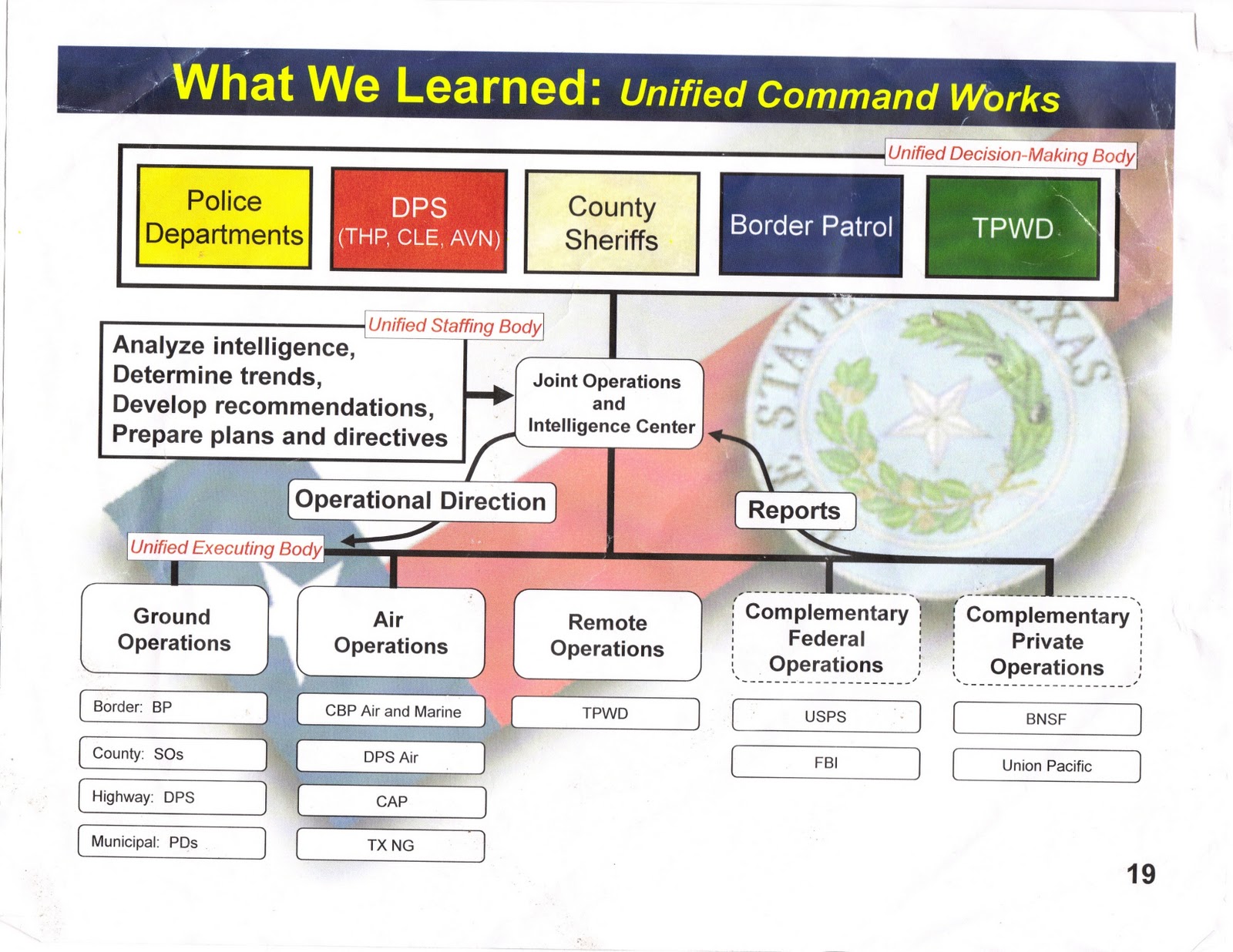
While Perry and McCraw routinely charge that Washington is not fulfilling its responsibility to control the border, they do more than complain. Since 2005 they have launched an array of high-tech and intelligence-centered border-security initiatives, including the Border Security Operations Center, Joint Operations Intelligence Centers, the TxMap border crime-mapping project, and “Unified Commands.” In addition, the governor’s office has supported -- with federal and state funding -- the border-security deployments of the border sheriffs, known as Operation Linebacker. Five years into the Texas model of border security, there is, however, little information about these operations and only vague assertions about their effectiveness.

Nonetheless, the Texas Public Safety Commission approved, without discussion, an “emergency procurement” contract between DPS and Abrams Learning & Information Systems (ALIS), the private contractor to which DPS has delegated its core border security operations. Prior to the transfer of the Department of Emergency Management to DPS in 2009, it was the Office of the Governor that outsourced border security operations.

 ALIS has two border security contracts – one to develop and operate the border crime-mapping project called TxMAp and a larger Border Security Operations and Management contract. Both have been routinely renewed without any public accounting of accomplishments. DPS has declined to fulfill an open records request for documents and progress reports mandated by these contracts.

 In a Nov. 15 letter to Attorney General Greg Abbott, DPS Asst. General Counsel Jennifer Cohen contends that “the reports are confidential” and “consequently must be withheld from public disclosure.” Among the public records requested were documents that DPS has contracted ALIS to produce.

These requested documents included:

• Most recent version of Texas Border Security Campaign Plan (Subtask 2.2);

• Program status reports for August 2010, September 2010, or most recent month available, including BSOC-specific monthly reports (Subtask 1.1); •

•ALIS’s plan to integrate the three fusion centers (Task 8); • Most recent version of the “comprehensive plan for conducting effective information operations” (Subtask 4.2);

• Most recent plan “for the conduct of unified information operations” (Subtask 4.2);

• Most recent monthly report from BSOC/ALIS (Subtask 4.2); and • Most recent edition of Border Sentinel.

The DPS letter makes the following case, citing legal precedents, for nondisclosure of these public records:

“[T]he Department believes this information is either confidential or extremely sensitive to ongoing law enforcement operations along the Texas-Mexico border. Operation Border Star is a comprehensive, multi-jurisdictional border security program. Some important goals of Operation Border Star are to arrest narcotics smugglers and human traffickers; interdict shipments of drugs coming from the border as well as money and weapons going to the border; and cripple the support structure used by smugglers and traffickers. Clearly, these are important law enforcement goals, particularly in light of the upsurge in border violence as drug cartels become increasingly confrontational toward each other and toward law enforcement officers"

“The requested reports contain detailed border operations, including pre-mission summaries, post-mission briefs, and mission analyses. All of these reports contain extensive information regarding the detection and investigation of crimes, including tactical plans, equipment details, critical assessments, and so forth.”

 “The information contained in the reports at issue would reveal highly sensitive information that, in the hands of criminals, would greatly impede the efforts of law enforcement officers along the border. For instance, revealing the equipment and tactics utilized by Texas law enforcement in their border security operations would help smugglers and traffickers avoid detection as they cross the border into Texas with illegal cargo. The analyses of weaknesses contained in the responsive reports would be even more beneficial to criminals seeking to avoid detection and prosecution. Accordingly, the Department believes these responsive records are excepted from required public disclosure. In addition to the discretionary exception to disclosure stated above, the Department believes the reports at issue are confidential by law and therefore must be withheld from public disclosure.”

 “As described above, the requested reports are prepared by the Department for the purpose of preparing for and analyzing law enforcement operations along the border. Numerous law enforcement agencies are part of the Operation Border Star program, and their teams detect, impede, and interdict narcotics smuggling and human trafficking across the border. Clearly, border security issues are extremely important to preventing terrorism and related activity. The reports at issue provide comprehensive information regarding the types and number of personnel utilized during border operations. In addition, the reports detail tactical plans before missions are carried out and analyze the success of those tactics after the missions.”

Governor Perry and DPS Director McCraw have promoted the Texas “model” or “paradigm” of border security as one that is having great success in the state and one that should be widely adopted. It is, however, a model that is almost exclusively in the hands of a Washington Beltway consulting firm – ALIS – that has been contracted over the past several years not only to implement the model but to design in.

 Yet neither the Public Safety Commission nor the state legislature has taken its oversight responsibilities seriously. As a result, basic questions about the Texas border security model remain unanswered, such as:

* What exactly are the Border Security Operations Center and Joint Operations Intelligence Centers that ALIS has created and staffed, and what kind of information and intelligence do they disseminate?
* Is there any vetting of the information and intelligence distributed by these outsourced border security institutions, and are civil liberties and privacy concerns respected?
* Where is the statistical evidence and crime data that demonstrated the effectiveness of ALIS’s border crime mapping and its “border security operations and management.”?
*Why are these contracts being routinely renewed without any accountability?
* What type of oversight is provided by the Texas Rangers Division, which DPS's McCraw recently put in titular charge of the BSOC and JOICs?

Public access to information about the structure and impact, as well as to the contract-mandated monthly progress reports from ALIS, will help Texans and Washington officials better understand the much-touted model of border security in Texas.

Research support for this series was provided by The Investigative Fund at The Nation Institute.


Also see, Tom Barry, "At War in Texas,"  Boston Review at: http://bostonreview.net/BR35.5/barry.php