Search

Tuesday, December 7, 2010

War on Drugs Has Mexico Running Scared


In December 2006, newly elected Mexican president Felipe Calderón donned military fatigues and declared a “war on drugs.” Washington, increasingly concerned about the steadily rising power of Mexico’s drug cartels, expressed its strong support for the Mexican president’s decision to deploy the Mexican military in this domestic war.


At President Bush’s behest, the U.S. Congress in 2008 approved the Merida Initiative, which authorized $1.3 billion on military assistance and other U.S. aid to Mexico (and to a lesser extent Central America) to fight the drug war and organized crime over three years.


Calderón’s decision to tap SEDENA – the National Defense Secretary – to direct the campaign against the drug trafficking organizations was never questioned by Washington policymakers. Even after two years of dubious accomplishments in army-led war on drugs, the new administration of Barack Obama opted to continue Washington’s whole-hearted support for Mexico’s war.


In the administration’s first year, DHS Secretary Napolitano, Drug Czar R. Gil Kerlikowske, FBI Director Robert Mueller, Counterterrorism Advisor John Brennan, and Secretary of State Hillary Clinton uniformly praised Calderón’s “courage” in taking on the cartels. The administration also continued its predecessor’s strong backing of the Merida Initiative.


The near-giddy enthusiasm at that time for Calderón and his declared war on drugs has given way more recently to a more sober evaluation of drug war, the role of the army, and binational cooperation.


By late 2009 the spectacular failure of the army’s offensive against the cartels – so evident in the disaster of “Operación Conjunto” in Chihuahua – obligated administration officials to tone down their acclaim for Mexico’s drug war.


WikiLeaks Revelations


The degree of the deepening frustration with its partner institutions in Mexico and the spreading gloom about the prospects for stability in Mexico came to light recently in the secret State Department cables released by WikiLeaks.


In marked contrast to the shine given to U.S.-Mexico cooperation in the four-year drug war in Mexico by U.S. officials, the diplomatic cables have revealed a more sober assessment of the relationship, the war’s progress, the capabilities of its Mexican partners, and of the Merida Initiative framework of cooperation.

After dining with Mexico’s then-Undersecretary of Interior Geronimo Guitierrez and U.S. Justice Department officials, one U.S. diplomat reported that Mexican officials had belatedly realized that the initiative was patched together with “not enough strategic thought” and with “too much emphasis in the initial planning on equipment.” An October 2009 cable reported that Gutierrez “expressed a real concern with ‘losing’ certain regions” of the country to the drug cartels. 

In a Nov. 9, 2009 cable, U.S. Ambassador Carlos Pascual wrote: "Mexico's use of strategic and tactical intelligence is often fractured, ad hoc, and heavily reliant on the United States for leads and operations." He lamented the “entrenched mistrust” and turf wars that obstructed collaboration among the various security forces in Mexico. They "would rather hoard intelligence than allow a rival agency to succeed."

The cables also point to the Mexican Army’s lack of modernization, its risk-avoidance, and its inability to adapt to its law enforcement mission.
Perhaps the most embarrassing assessment about Calderón’s drug war strategy came in cable communication that praised the cooperation and operations of the Mexican Navy (SEMAR), which operates apart from the SEDENA and the Mexican Army.

One cable noted that SEMAR “has shown itself capable of responding quickly to actionable intelligence. Its success [in hunting down drug kingpin Arturo Beltrán Leyba] puts the Army … in the difficult position of explaining why it has been reluctant to act on good intelligence and conduct operations against high-level targets.” 

The Dec. 17, 2009 cable stated, “The U.S. interagency originally provided the information [about Beltrán Leyba’s whereabouts] to SEDENA, whose refusal to move quickly reflected a risk aversion that cost the institution a major counternarcotics victory.”

Despite U.S. commitment’s to assist in the modernization of Mexico’s judicial system, the State Department communications bemoan the country’s low prosecution rates. According to one cable, “Prosecution rates for organized crime-related offenses are dismal, 2 percent of those detained are brought to trial. Only 2 percent of those arrested in Ciudad Juarez have even been charged with a crime.”

In an apparent reference to corruption in Mexico’s security forces, a WikiLeaks-distributed cable bemoaned the persisting need for “the development of strong trust through proper vetting.”  Later, the cable writer noted, “It would also be excellent to get to the point where there is no longer impunity for ‘Chapo’ Guzmán.” Guzmán heads the Sinaloa Cartel and is regarded as one of the world’s richest individuals.

Hope Turns to Cynicism


Cynicism about the drug war – and just about everything to do with politics and governance – is overtaking hope in Mexico.


Initially, Calderón’s commitment to confront the cartels with the Mexican Army, together with his promises to overhaul the federal police and the country’s deeply flawed judicial system, was widely supported in Mexico, bolstering his own legitimacy after a bitterly contested election and raising hope that a war against the cartels was winnable.


The Mexican government can boast of a string of arrests or killings of major cartel figures. But the scourge of narco-violence not only continues, it is intensifying and spreading.


Perhaps even more disconcerting is the knowledge that violence isn’t the only indicator of the presence of organized crime. Calm in the streets may also point to organized crime penetration.


The absence of narco-violence in a town, municipality, or region can also be a sure indicator that organized crime has consolidated its control over this territory.


Because of the cowed and co-opted state of much of the Mexican media, particularly outside the major metropolitan areas, there is little information about the full extent of organized crime’s power and reach.  As a result, Mexicans don’t know what is happening in their own towns and states.


What news that does surface about the drug-trafficking organizations – their capacity for violence, their diversification into other criminal and legitimate businesses, and their insistence on the acquiescence of politicians and police – lends increasing credibility to the hypothesis that the Mexican state is not only weak and corrupt but is also fundamentally endangered and now running scared. 

Sunday, December 5, 2010

Is Mexico a Failed or Failing State?


Sign on Arizona border ranch. Grassroots right and left find
common ground in simplistic anti-free trade analysis of 

U.S.-Mexico relations/ Photo by Tom Barry
Concerns that Mexico may become a failed state have induced a spate of doctrinaire and muddled analysis by both the right and the left. On both sides, ideologues have tapped the failed state debate as an opportunity for tirades -- about the federal government’s insufficient commitment to border security and immigration enforcement on the right, and about U.S. imperialism and free trade on the anti-globalization left.

On the left, Manuel Pérez-Rocha, an analyst with the Institute for Policy Studies, rightly challenged the alarmism about Mexico’s failed state prospects. “Labeling Mexico a potential ‘failed state’ is a false and dangerous distraction from the country's real problems,” he wrote in a Feb. 23, 2009 commentary for IPS’ Foreign Policy In Focus.
What are those real problems? In keeping with dogma of the anti-economic globalization left, Mexico is not a failed state but its central problems, including narco-violence, can be attributed to the failed free trade model and NAFTA,  according to Pérez-Rocha.
“While drug cartels have managed to corrupt many officials at the state, local, and national levels of government, as well as in the police departments and the military, there are no indications that the Mexican state — or any individual Mexican state — is on the brink of dissolution or disintegration,” Pérez-Rocha wrote in February 2009. “Mexico still has strong institutions that millions of people work and struggle every day to defend, including relatively well-functioning public services such as health and education.”
Where the threat comes from is the global economy and U.S. trade policy. “Today it's clearer than ever that Mexico's unfettered opening-up to the global economy has made it exceptionally vulnerable,” he asserts.
Pérez-Rocha faults President Calderón for his “neoliberalism.” Since the creation of the North American Free Trade Agreement (NAFTA) in 1994, he contends that “conservatives have touted the country as a successful example of ‘neoliberal’ reforms, including trade and investment liberalization, deregulation, and privatization. NAFTA promoters heralded the increase in trade and investment flows between the three North American countries.”
“Mexico is in crisis, but the roots of that crisis are the economic policies that have created such widespread hopelessness and despair,” he wrote – repeating the same anti-free trade, anti-NAFTA mantras that the left’s anti-economic globalization activists have relied on as a substitute for analysis over the past two decades.
For Pérez-Rocha -- and many others on the left -- the narco-violence in Mexico can be largely explained by the ravages of free trade.
No doubt, as he observed, that NAFTA “failed to deliver promised gains in poverty reduction or wage growth.” But as an explanation for the increasing reach of ungoverned spaces in Mexico, the horrific drug-related violence, the country’s systemic corruption, the absence of any commitment to the rule of law, or Mexico’s social disintegration, it falls far short.
Connections can be made, but the neither the roots of Mexico’s current narco-violence crisis nor the country’s other long-simmering crises such as its out migration, endemic corruption, or centralized political system can be found in the free trade model.
Left dogma often turns delusionary.
That’s the case in James Cockcroft’s new essay, “Mexico: ‘Failed States,’ New Wars, Resistance,” in Monthly Review.
Mexico isn’t a failed state but merely a pliable subaltern in the empire, according to Cockcroft.  That’s been his analysis of Mexico and the rest of Latin America over the past four decades.
“It is not a failed state because it carries out well the tasks assigned to it in the empire’s design,” writes Cockcroft in the socialist Monthly Review. “All Washington’s propaganda backs up the militarization of Mexico in order to protect the interests of transnational corporations and foreign banks.”
No need for any new analysis thinking about Mexico. The shop=worn anti-imperialist, anti-monopoly capitalism analysis will do just fine, in his view, for pressing questions about narctrafficking, organized crime, and governance in Mexico.
Cockcroft sees conspiracy in U.S. aid for President Calderón’s three-year drug war. “Sponsored by Washington and its allies,” the drug war has nothing to do with ‘national security’ or ending the drug traffic.” Rather, the drug war is a cover for a war against Mexico’s nationalist, popular forces. In Mexico and elsewhere, according to Cockcroft, the “’failures’ of the campaigns against the narcotraffic help to justify war, state violence, and massive repression in whole societies.”
In the view of Cockcroft, what we are seeing in Mexico is a “right-wing offensive, which, building on twenty-eight years of neoliberal economic policies, has led to the country’s increasing militarization.” The right-wing offensive unleashed by Calderón has taken the form of “a reign of terror.” This veteran Mexico observer says that “broad-based social movements are resisting” this offensive.
It’s all a transnational conspiracy. According to Cockcroft:
“What are the real targets of these plans for the international coordination and militarization of the struggle against supposed terrorists and narcos? The plans are aimed at immigrants, original peoples, guerrilla resistance, political dissidents, and social movements protesting transnational corporations that take over water and cause mining pollution. These plans, financed by billions of dollars, have made Mexico a security priority for the U.S. ruling class… They do not know that this war is an excuse for militarizing the nation.’
Dogma deludes. Cockcroft, like others in the hard left (both here and in Mexico), is delusionary about the centrality of the “empire” in determining Mexico’s political economy. Equally dogma-driven are his assertions about the hidden counterrevolutionary agenda of the drug war.
He also lauds a popular resistance that most other observers of Mexican politics haven’t detected.
Cockcroft finds hope in that “nationalist forces are resisting” the “galloping privatization” that is “overrunning the energy sector,” without any acknowledgment of the hopeless state of the state energy company PEMEX.
“The new popular protests are mainly defensive,” he admits, “however much spiced by calls for a ‘revolutionary offensive,’ a ‘Constituent Assembly,’ and ‘national sovereignty.’ Right now, the correlation of forces does not favor human liberation.”
“But you never know,” he says, apparently hopefully, “at what moment the creation of fear in a society will turn into an expansion of rage and rebellion—an explosion of ‘popular power’ organized from below.”  Clearly, the governance and development strategy in Mexico badly need an overhaul.
But would a raging “popular explosion” -- particularly along the revolutionary offensive, nationalist, and socialist lines Cockcroft still favors -- lead to improved governance and improved social welfare? What would happen to Mexico’s still emerging system of representative democracy in Mexico?
Cockcroft writes off the system of multiparty, representative democracy, noting that all the major political parties have become neoliberal and corrupt.” There are, however, no words of criticism or caution about the armed “resistance.”
“There are a dozen guerrilla groups operating in Mexico but they are small and divided,” writes Cockcroft, “During this period of popular protests, they have done no shooting. All resistance is peaceful…for the moment” – as if to say that another revolution is around the corner, and bienvenido.
Good analysis about the stability and reach of the state in Mexico is hard to find anywhere. But the lack of an attempt of serious analysis within the traditional left is particularly shocking and dismaying.

Both in the United States and in Mexico, the left’s dismissive assessments about the value of representative democracy and its tendency to lay the blame for all problems on free trade, U.S. imperialism, and transnational capital blind it to the real security threats faced by the Mexican state and the Mexican people.

Although Mexico is certainly not a failed state, organized crime’s control of increasingly large swaths of national territory merits more serious analysis.

Friday, December 3, 2010

Mexico: Narco-Violence and a Failed State?


If you are looking for an in-depth examination of the likelihood that narco-violence will turn Mexico into a failed state, you won’t find it in the new book by veteran Mexico observer George Grayson. 

Grayson does examine in great detail the rise of the Mexican drug cartels while also closely detailing the development of the modern Mexican state. But he gives only cursory treatment to the failed state question presented in the book’s title while offering strangely contradictory tidbits of assessment on the country’s prospects for deep instability.

Nor does the book provide much in the way of insight or analysis of the drug-related violence that has besieged sections of the northern border region and other parts of the country. Questions about the geographic concentration of the violence, the degree to which narco-violence is related to the local or U.S. market control, or the role of the military in spreading the violence, among others, go mostly unaddressed.

The absence of hard analysis and sharp perspective on the issues raised in the book’s title is all the more annoying given the increasingly widespread acceptance of the notion that Mexico is a failed state.  It’s a notion that is increasingly deployed as an argument for increased border security spending and stricter immigration enforcement, both at the state and federal levels.

Grassroots border-security hardliners and right-wing politicians have long raised alarm about Mexico’s political and social stability. It wasn’t, however, until pronouncements by officials and agencies of the outgoing Bush administration in 2008-2009 about Mexico-sourced threats to U.S. national security that assessment of Mexico as a failed or failing state became more broadly considered.

Immediately before Obama moved into the White House, the U.S. Joint Forces Command issued its annual Joint Operating Environment report warning that Mexico – along with Pakistan – should be considered as nation at risk of “a rapid and sudden collapse.”  

With no accompanying analysis, the Pentagon report observed that “the growing assault by the drug cartels and their thugs on the Mexican government over the past several years reminds one that an unstable Mexico could represent a homeland security problem of immense proportions to the United States.”

What is more, while the Pentagon report acknowledged that Mexico’s collapse “may seem less likely” than the disintegration of Pakistan, it warned:

“[T]he government, its politicians, police, and judicial infrastructure are all under sustained assault and pressure by criminal gangs and drug cartels. How that internal conflict turns out over the next several years will have a major impact on the stability of the Mexican state. Any descent by Mexico into chaos would demand an American response based on the serious implications for homeland security alone.”
The credibility of assertions that the U.S. southwest borderland and U.S. homeland security were threatened by drug violence in Mexico was also bolstered at the end of the Bush administration by the warning in the National Drug Threat Assessment 2009 that “Mexico drug trafficking organizations represent the greatest organized crime threat to the United States.”

Shortly before leaving office, Department of Homeland Security secretary Michael Chertoff contributed to level of alarm about Mexico and border violence. Chertoff told the New York Times that the U.S. government had recently completed a “contingency plan for border violence” and the U.S. military would be brought in as part of a “surge” to work with DHS “assets.”

For his part, outgoing CIA director Michael Hayden warned that Mexico along with Iran would like by the top policy challenges for the incoming president.

The likelihood that Mexico may soon devolve into a failed state has been widely dismissed by most close observers. In Mexico, the ill-considered assessment of the country as U.S. national security threat have been met with derision and outrage by the government and most Mexican analysts.

But, over the past two years, the failed state thesis has provided official cover in the United States for the escalating calls, mostly from the right, for more border security, including the deployment of the U.S. military and National Guard.

A book-length examination of the failed or failing state theses would be a valuable contribution to a fuller understanding – both in the United States and in Mexico – of the governance and security threats associated with narco-violence. It would also inform U.S. policy discussions of “border security” and drug-war aid, notably the Merida Initiative.

The phrase “failed state” appears not only in the book’s title but also in the two final chapters – which makes it all the more remarkable that Grayson gives only passing attention – a couple of pages -- to the question. And what little attention that is given to the question leaves one wondering where exactly he stands on the question.

In the book’s introduction, Grayson points to analysis by several Mexican scholars and journalists that point to what he describes as the “surging debility of a Mexican state whose fragmentation is concomitant with increasing opportunities for drug lords to go about their nefarious trade with impunity.”

The author cites Luis Rubio, director of Mexico City’s Centro de Investigación Center para el Desarollo (CIDAC), stating that “our weaknesses as a society are formidable not only in the police and judicial domains, but also in the growing erosion of the social fabric and the absence of a sense of good and bad…”

Seemingly casting his lot with those who regard Mexico as a state imminently facing the risk of failure, Grayson writes:
“Among factors that uphold the ‘weak’ and ‘failed state” arguments are: a soaring murder rate, a jump in sadistic executions, increased kidnappings, prison escapes, the venality of local, state, and federal police, a failure of policy makers to enforce safety codes, and disenchantment with institutions occupied by officials who often live like princes even as 35 percent of Mexico’s 110 million people eek [sic] out a living in hardscrabble poverty.”
“Evidence of a failed state becomes apparent in efforts to immigrate to the United States,” continues Grayson.

By the end of the book, after devoting numerous chapters to the history of Mexican state, the drug cartels, and U.S. counternarcotics policy, Grayson offers an ambiguous conclusion.

On the one hand, he emphasizes the weakness of the state and the superficiality of the democratic system. Grayson notes that, while Freedom House and the Fund for Peace give Mexico relatively high marks, their criteria – such as regular elections and presence of a multiparty competitive system – focus on “processes rather than practices” and “overlook the chasm between the political elite and grassroots’ constituents, breeding in the latter a sense of helplessness.”

He points to various flaws in the electoral and political systems – including systemic corruption, the prohibition against independent candidates, dominance of party chiefs, absence of run-offs, ban on reelecting chief executives, and forbidding civic groups from airing media ads during campaigns – that weaken the state and distance it from grassroots constituencies.

But then, on the other hand, Grayson veers away from his thesis about a fundamentally weak and fatally flawed Mexican state, asserting:
 “Only a Cassandra in deep funk could conclude that Mexico will implode as is possible in Afghanistan or Pakistan. There are too many factors – the Mexican armed forces, the Roman Catholic Church, the middle calls, the Monterrey business community, the banking system, labor and professional organizations, the U.S. government, and international financial institutions, etc. – to let this happen.”
Oddly, this slight treatment is about far as Grayson goes in explaining why -- despite the ravages of the drug war and the large sections of virtually ungoverned territory – the Mexican state will likely remain fairly strong for the foreseeable future. It is also noteworthy -- but understandable given his deep cynicism about Mexican politics -- that Grayson does not include the representative political system among the factors for stability – probably because he sees this system as the facilitating the resurgence of the former ruling party in the last couple of years.

Mexico: Narco-Violence and a Failed State? is a mixed bag. While the analysis on the issues presented in the book’s title is sparse and disappointing, the book, nonetheless, is a valuable contribution for a number of reasons.

One of the virtues of the book is Grayson’s examination of the rise and evolution of the modern Mexican state. Too often the U.S. discussion of Mexico comes without any political context. What makes his examination of the state and politics in Mexico so fascinating is the recent return of the PRI as the country’s major political force – an ominous trend, according to Grayson, given the PRI’s history of patronage politics, its opportunistic “revolutionary nationalism,” and its unreformed ways.

As Grayson explains, PAN, the historic opposition party that captured the presidency in 2000 and 2006, has not fully dismantled the corporatist structures. Nor has it succeeded in moving the country beyond the ideology of “revolutionary nationalism” that has animated the state since the 1930s, as evident in the failure to open up the petroleum production sector to much-needed foreign investment.

Grayson comes down especially hard on two social sectors that formed part of the PRI’s corporatist infrastructure – the SNTE teacher’s union (with annoyingly repeated references to the power of Elba Esther Gordillo) and the PRI-allied unions in the state’s oil and electricity companies.

The book is also valuable as a reference volume. An abundance of tables and appendices set out the main personages, institutions, and events in the drug war.

Another excellent contribution is the author’s overview of the various strategy options for addressing the challenges to state authority and social stability presented by the drug trafficking organizations – the main ones being 1) a more focused and strategic drug war against the cartels, 2) a return to the PRI practice of reaching a modus vivendi with the main criminal syndicates, and 3) decriminalization.

Grayson should also be commended for adding his voice to those calling for the end of the U.S. drug war. In the concluding paragraph of the book’s final chapter, Grayson writes:
“Drug abuse is bad, but the drug war is worse. Few public policies have compromised public health and undermined our fundamental and civil liberties for so long and to such a degree as the war on drugs.”

Wednesday, November 17, 2010

Texas Confidential: Perry's Touts State's Secret Model of Border Security

(Another article in a Border Lines series on outsourcing border security in Texas.)

 “We know how to secure the border,” Gov. Rick Perry told Fox News in the wake of his reelection. Perry, who is promoting his new book, Fed Up: Our Fight to Save America from Washington, told Fox that “this administration and frankly this Congress have been abject failures [at securing the border] and have been for many years now.”

 But what exactly is Perry doing in Texas, and how can it be assessed?

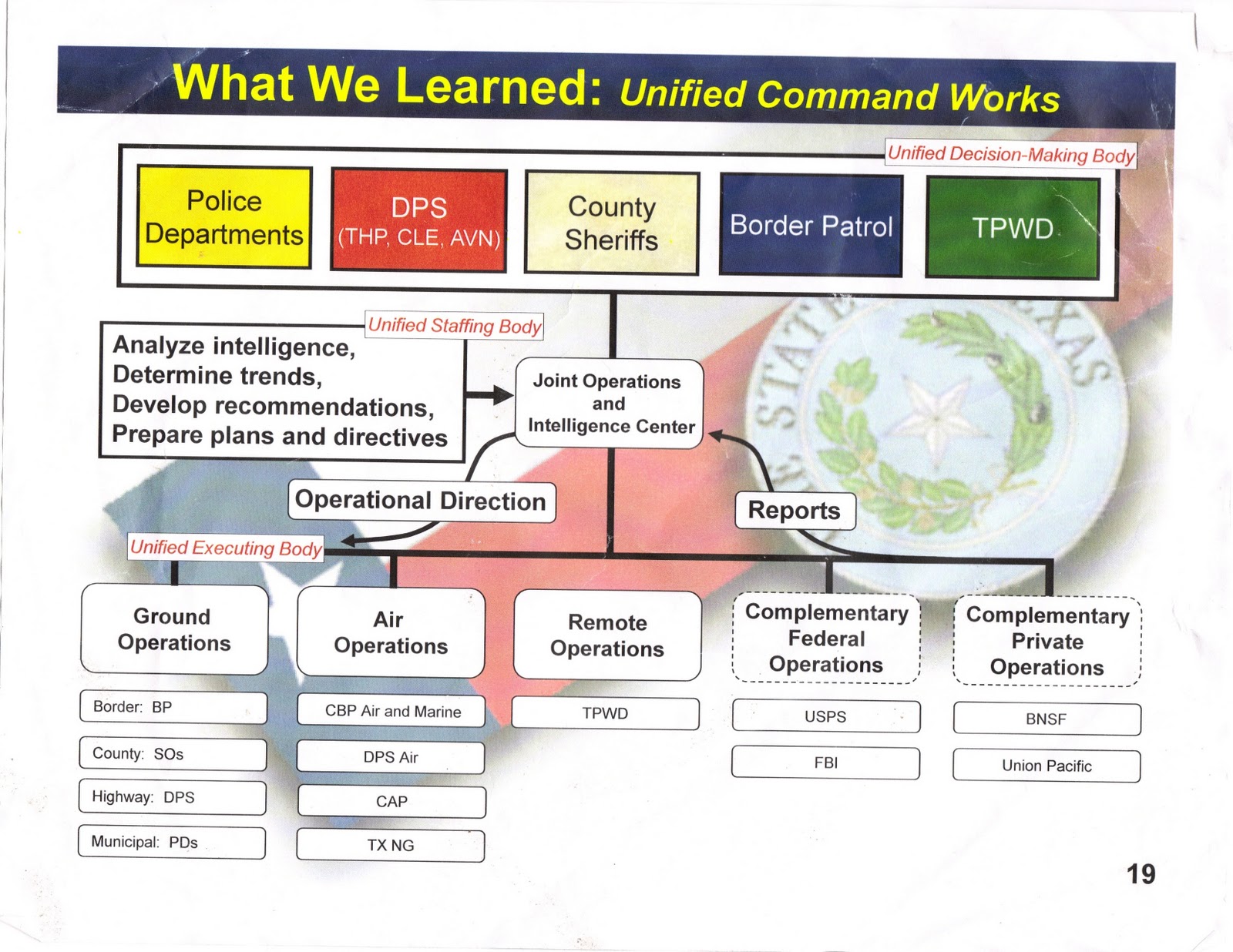
Perry and his chief of homeland security Steve McCraw, who also serves as director of the Texas Department of Public Safety (DPS), explain that the Texas model of border security comprises an array of innovative strategies and operations that other border states and the federal government should adopt.

While Perry and McCraw routinely charge that Washington is not fulfilling its responsibility to control the border, they do more than complain. Since 2005 they have launched an array of high-tech and intelligence-centered border-security initiatives, including the Border Security Operations Center, Joint Operations Intelligence Centers, the TxMap border crime-mapping project, and “Unified Commands.” In addition, the governor’s office has supported -- with federal and state funding -- the border-security deployments of the border sheriffs, known as Operation Linebacker. Five years into the Texas model of border security, there is, however, little information about these operations and only vague assertions about their effectiveness.

Nonetheless, the Texas Public Safety Commission approved, without discussion, an “emergency procurement” contract between DPS and Abrams Learning & Information Systems (ALIS), the private contractor to which DPS has delegated its core border security operations. Prior to the transfer of the Department of Emergency Management to DPS in 2009, it was the Office of the Governor that outsourced border security operations.

 ALIS has two border security contracts – one to develop and operate the border crime-mapping project called TxMAp and a larger Border Security Operations and Management contract. Both have been routinely renewed without any public accounting of accomplishments. DPS has declined to fulfill an open records request for documents and progress reports mandated by these contracts.

 In a Nov. 15 letter to Attorney General Greg Abbott, DPS Asst. General Counsel Jennifer Cohen contends that “the reports are confidential” and “consequently must be withheld from public disclosure.” Among the public records requested were documents that DPS has contracted ALIS to produce.

These requested documents included:

• Most recent version of Texas Border Security Campaign Plan (Subtask 2.2);

• Program status reports for August 2010, September 2010, or most recent month available, including BSOC-specific monthly reports (Subtask 1.1); •

•ALIS’s plan to integrate the three fusion centers (Task 8); • Most recent version of the “comprehensive plan for conducting effective information operations” (Subtask 4.2);

• Most recent plan “for the conduct of unified information operations” (Subtask 4.2);

• Most recent monthly report from BSOC/ALIS (Subtask 4.2); and • Most recent edition of Border Sentinel.

The DPS letter makes the following case, citing legal precedents, for nondisclosure of these public records:

“[T]he Department believes this information is either confidential or extremely sensitive to ongoing law enforcement operations along the Texas-Mexico border. Operation Border Star is a comprehensive, multi-jurisdictional border security program. Some important goals of Operation Border Star are to arrest narcotics smugglers and human traffickers; interdict shipments of drugs coming from the border as well as money and weapons going to the border; and cripple the support structure used by smugglers and traffickers. Clearly, these are important law enforcement goals, particularly in light of the upsurge in border violence as drug cartels become increasingly confrontational toward each other and toward law enforcement officers"

“The requested reports contain detailed border operations, including pre-mission summaries, post-mission briefs, and mission analyses. All of these reports contain extensive information regarding the detection and investigation of crimes, including tactical plans, equipment details, critical assessments, and so forth.”

 “The information contained in the reports at issue would reveal highly sensitive information that, in the hands of criminals, would greatly impede the efforts of law enforcement officers along the border. For instance, revealing the equipment and tactics utilized by Texas law enforcement in their border security operations would help smugglers and traffickers avoid detection as they cross the border into Texas with illegal cargo. The analyses of weaknesses contained in the responsive reports would be even more beneficial to criminals seeking to avoid detection and prosecution. Accordingly, the Department believes these responsive records are excepted from required public disclosure. In addition to the discretionary exception to disclosure stated above, the Department believes the reports at issue are confidential by law and therefore must be withheld from public disclosure.”

 “As described above, the requested reports are prepared by the Department for the purpose of preparing for and analyzing law enforcement operations along the border. Numerous law enforcement agencies are part of the Operation Border Star program, and their teams detect, impede, and interdict narcotics smuggling and human trafficking across the border. Clearly, border security issues are extremely important to preventing terrorism and related activity. The reports at issue provide comprehensive information regarding the types and number of personnel utilized during border operations. In addition, the reports detail tactical plans before missions are carried out and analyze the success of those tactics after the missions.”

Governor Perry and DPS Director McCraw have promoted the Texas “model” or “paradigm” of border security as one that is having great success in the state and one that should be widely adopted. It is, however, a model that is almost exclusively in the hands of a Washington Beltway consulting firm – ALIS – that has been contracted over the past several years not only to implement the model but to design in.

 Yet neither the Public Safety Commission nor the state legislature has taken its oversight responsibilities seriously. As a result, basic questions about the Texas border security model remain unanswered, such as:

* What exactly are the Border Security Operations Center and Joint Operations Intelligence Centers that ALIS has created and staffed, and what kind of information and intelligence do they disseminate?
* Is there any vetting of the information and intelligence distributed by these outsourced border security institutions, and are civil liberties and privacy concerns respected?
* Where is the statistical evidence and crime data that demonstrated the effectiveness of ALIS’s border crime mapping and its “border security operations and management.”?
*Why are these contracts being routinely renewed without any accountability?
* What type of oversight is provided by the Texas Rangers Division, which DPS's McCraw recently put in titular charge of the BSOC and JOICs?

Public access to information about the structure and impact, as well as to the contract-mandated monthly progress reports from ALIS, will help Texans and Washington officials better understand the much-touted model of border security in Texas.

Research support for this series was provided by The Investigative Fund at The Nation Institute.


Also see, Tom Barry, "At War in Texas,"  Boston Review at: http://bostonreview.net/BR35.5/barry.php

Monday, November 15, 2010

Alternative to Border Security Boom on Arizona-Sonora Border


(Part of a Border Lines series on border security on Cochise County and Agua Prieta.)

Pedro Maldonado of Café Justo in Agua Prieta/Tom Barry
Cochise County is the epicenter of border security.

The killing of prominent Cochise County rancher Rob Krentz last March by a suspected illegal border crosser precipitated a border security firestorm in Arizona – leading to Gov. Jan Brewer’s approval of the controversial SB 1070 bill, the governor’s creation (with federal stimulus funding) of the Border Security Enhancement Program, and the increased deployment of Border Patrol agents to southeastern Arizona border.

Cochise County Sheriff Larry Dever cofounded (with Pinal County Sheriff Paul Babeu) Border Sheriffs.com and became a national voice for a border and immigration crackdowns.

While the killing of the rancher led to national attention to border security in Cochise County, this Arizona border county has been the focus of border crackdown campaigns since the 1990s. Leading the way were vigilante groups like the Minutemen, American Border Patrol, Civilian Defense Fund, and Cochise County Concerned Citizens, as well as the Texas-based Ranch Rescue.

As border control tightened along traditional crossing corridors in the mid-1990s, especially in the El Paso and San Diego areas, illegal border crossers sought other routes that weren’t as heavily patrolled and guarded. 

Responding to the surge of immigrant flows through southeastern Arizona, the Border Patrol launched Operation Safeguard 99, which included intensive Border Patrol deployment. Hotels in Douglas, the border town that hosted the Border Patrol’s district station, filled with Border Patrol agents in 1999.

At a time when border vigilantism and federal deployment were intensifying, there were other forces working to integrate the two sides of the border. The North American Free Trade Agreement (NAFTA) of 1992 boosted the maquila sector in Agua Prieta, the sprawling Sonoran town that lies opposite it much smaller border twin, Douglas.

The expanding maquila sector in Agua Prieta attracted thousands of women and men from southern Mexico, with an especially large number from Chiapas. As coffee prices plummeted in the mid-1990s, small coffee growers left their land to seek a livelihood in the only formal economic sector that was expanding in Mexico – the exported-oriented maquilas that assembled imported components destined for foreign markets.

Among those chiapanecos working in the maquilas, assembling car parts and seat belts, was Eduardo Perez Verdugo, who had left his mountain village near the Guatemalan border to come 2,000 miles to the U.S. border. Hurricane Mitch had devastated his town, and in 1998 he traveled north with his son, where they made $47 for a 48-hour work week. Seeking more income to support his family back in Chiapas, Perez unsuccessfully tried crossing the border to seek a job at a Phoenix golf course.

Both in Chiapas and in Agua Prieta, Perez had attended services at Presbyterian churches. After being deported, in conversations with Mark Adams, the minister of the Lily of the Valley Presbyterian Church in Agua Prieta, a vision of a cross-border economic integration project slowly emerged.
“To leave our land is to suffer,” Perez said, “If only we could control the sale of our coffee, we would be able to stay on our land.”

More than a decade later, the binational Presbyterian ministry, Frontera de Cristo, has made this vision a dynamic economic development project that turned despair into hope – and a sustainable livelihood – for dozens of coffee farmers in Chiapas. Across from the Lirios del Valle church in Agua Prieta now stands the roasting and marketing center for Café Justo/Just Coffee.
Frontera de Cristo Coordinators Angel Valencia and
Mark Adams/ Photo by Tom Barry


Visiting the Other Side of Border Security

A visit to the U.S.-Mexico border is likely to shock and depress.  At a time when debt and deficits are defining the political debate, the region oozes with federal dollars. No expense is spared to “secure the border.”

Border control costs the nation more than $10.5 billion annually (not including the $5.5 billion for immigration enforcement), and border security advocates in Congress pass measures to increase the number of Border Patrol and to bolster border fortifications.

A region, once prideful of its cultural diversity, is now being defined by the extremes employed to control the international divide.

But there are countervailing trends, while not necessarily more powerful, are certainly more hopeful – while costing nothing to U.S. taxpayers.

In 1984 the U.S. and Mexican Presbyterian churches joined together in a common border mission called Frontera de Cristo with six binational centers along the border.

Next to the Mexican customs and immigration office at the port of entry is the Centro de Migrantes, one of the numerous projects supported by Frontera de Cristo. Like most of its other projects, the immigrant center is a joint effort of other church groups, particularly the Catholic Church in Douglas and Catholic Relief Services, and community groups. “We always try to work cooperatively,” noted Adams. “Rarely do we do anything alone.”

In the case of its Water for Life project, which leaves strategically located barrels of water for migrants crossing ranch lands on the Mexican side of the border, the Frontera project even counts on the cooperation of the municipal government of Agua Prieta.

While most of its numerous projects are service-oriented -- like its New Hope community center, health clinic, and involvement in the city’s substance-abuse treatment center CRREDO -- Café Justo aims not just to serve but also to solve structural problems.

I visited Café Justo on the eve of what the staff call the “Día de Exportación.” It’s a time when the Agua Prieta members of the cooperative are preparing bags of coffee to meet the expanding U.S. market.
Preparing coffee for "Día de Exportación"/Tom Barry


It took a few years to turn the vision of Sr. Perez into a reality. The idea of a fair trade economic project that would unite small producers with U.S. consumers had been percolating for a few years. 

All started coming together in 2002 through additional brainstorming among Mark Adams and Daniel Cifuentes, another former coffee farmer who found work in the maquilas, and Tommy Bassett, a maquila manager who became excited about the prospect and offered his full-time management and business expertise to concept. Through a $20,000 loan from the Presbyterian Church USA, Café Justo purchased a coffee roaster.

The project currently supports 40 coffee growers in Salvador Urbina, the home village of Daniel Cifuentes. Now, rather than leaving for work on the border or to cross illegally into the United States,  to support their families, the women and men of this semi-tropical village are tending their coffee bushes.

Once harvested, the coffee beans are dried and then shipped in burlap bags to Agua Prieta. No longer obligated to sell their produce to coffee buyers, known as coyotes, the coffee cooperative sends their beans to its border branch facility, where their coffee is roasted and prepared for market.

Sitting on the porch the Frontera de Cristo house in Douglas, Adams told me that the obvious success story of Café Justo has been its ability to build a sustainable enterprise that supports its members and keeps them in their villages (the project has recently expanded to four other villages, three of which are in other southern Mexico states). 

“But the success is also making international connections real for our coffee consumers,” he said. “Fair trade is not just ideology but a real relationship that now exists between the cooperative members and those drinking Café Justo coffee. It’s not just fair trade, with growers getting a fair price, but it is real trade, a real relationship that makes people feel good.” 

It’s all part of Frontera de Cristo’s vision of sustainable and just binational relations through its Just Trade Center and other projects.

As Café Justo’s mission states:
“Café Justo's mission is to deliver the highest quality, organic, environmentally conscious, fresh roasted coffee to our customers at a price that is fair and just. We work to create a bond between the members of the coffee growing community in Salvador Urbina and our customers throughout the world.”
Back in Salvador Urbina, life has changed dramatically since the mid-1990s when the men and boys, and then the women, started leaving in droves. It used to be that ad-hoc bus companies would regularly announce by megaphone “Departures to Agua Prieta” and other border locations like Altar and Tijuana.

The stagnant U.S. economy and increased border control measures only partially explain that these advertised “salidas al Norte” are no longer the central feature of life in Salvador Urbina.

Thanks to Café Justo, these chiapanecos are staying home, finding ways to improve their coffee crops, fixing their homes, and communicating by internet with fellow cooperative members in Agua Prieta and other family members at the cooperative’s internet café.

(To get involved – buying Café Justo coffee, making a donation, visiting the project in Agua Prieta or in Chiapas -- and beat the border security blues, contact: sales@justcoffee.org To read more, read the inspiring story of Café Justo in Just Coffee: Caffeine with  Conscience by Mark Adams and Tommy Bassett, available from Just Trade Center.)