Search

Saturday, March 20, 2010

Center for Immigration Studies Strikes Back


A lengthy report by the Center for Immigration Studies released on March 18, 2010 is titled “Immigration and the SPLC: How the Southern Poverty Law Center Invented a Smear, Served La Raza, Manipulated the Press, and Duped its Donor.”  

The report targets SPLC and the National Council of La Raza (NCLR) for their role in an ongoing campaign to fight hate against immigrants and Latinos. According to the new report, “The SPLC’s decision to smear FAIR [Federation for American Immigration Reform] was the work of a kangaroo court, one convened to reach a pre-determined verdict by inventing or distorting evidence. The ‘Stop the Hate’ campaign would more accurately be labeled as a campaign to ‘Stop the Debate.’”

Although highly critical of SPLC’s methodology and motives, the CIS report doesn’t closely examine the details of SPLC’s charge that FAIR is hate group and as such bears responsibility for hate crimes against Latinos. Nor does the report examine the existence of hate groups and hate crimes in relation to the escalation of the immigration debate in this country.

Instead, the CIS reports strikes back at two of the principals in the campaign to delegitimize the immigration restrictionist institutes, including CIS. The new report examines the integrity and credibility of SPLC and the National Council of La Raza, the civil rights group that relies on SPLC research for its “Stop the Hate” website.

According to the CIS report, “Rather than engage in a debate, La Raza and its allies have waged a campaign to have the other side shunned by the press, civil society, and elected officials. It is an effort to destroy the reputations of its targets. It also seeks to intimidate and coerce others into silence. It undermines basic principles of civil society and democratic discussion.”

Written by former journalist Jerry Kammer, currently a senior research fellow at CIS, the report is a must read for those who closely follow the immigration debate.

While making little contribution to our understanding of the virulence of anti-immigrant rhetoric in the public debate, the CIS report offers fascinating observations about the role of John Tanton. The current and historical links of FAIR, CIS, and NumbersUSA have formed the core of the criticism of these restrictionist institutes by immigrant-rights groups.

The report notes these connections:

“John Tanton founded FAIR in 1979. Six years later he was one of several individuals who were instrumental in starting the Center for Immigration Studies. CIS operated under FAIR’s non-profit umbrella for about six months, until its independent non-profit status was approved. In the late 1990s Tanton helped launch NumbersUSA. Because of the prominent role these organizations have played in the national immigration debate, he can rightly be described as the father of the modern movement to restrict immigration.”

According to Kammer, “[T] small-town doctor from Northern Michigan combines relentless organizational energies with a provincial temperament and a tin ear for the sensitivities of immigration. In an arena that requires the ability to frame issues in a way that broadens consensus, he sometimes speaks with a free-wheeling bluntness that can upset even those who admire him. Some say that Tanton has shown a tendency to be unnecessarily provocative, a tendency that some have seized upon to change the topic from immigration to Tanton himself.”

An interview with Roger Conner, the first executive director of FAIR, also touches on motivations and perceptions in the immigration debate. Conner told Kammer, “Immigration touches so many sensitivities and stirs so many passions that it requires careful handling by those who seek to change policy. Talking about Tanton, Conner said, “It is not enough to “be racially inclusive in your heart,” he said. “You have to avoid even the appearance of bigotry.”

Kammer writes, “Conner has a blunt message to those who complain of a double standard: ‘You’re right — it isn’t fair. Get over it.’” “‘Motives matter on immigration,” said Conner, “The risk of a big-tent philosophy was — and is — that if you don’t explicitly exclude the fringe groups from your tent, you can ruin it for the majority of Americans — those of us who are just as opposed to intolerance or racism as we are to excessive immigration.”

SPLC and its allies in this campaign stand on their strongest ground when they point to the highly objectionable activities and rhetoric of many of the grassroots groups associated with FAIR.

FAIR’s publications and media statements generally stick closely to the institute’s contentions about mass immigration and the “open borders” goals of CIR advocates. But there is ample evidence that grassroots organizations and activists allied with FAIR do indeed have white supremacist and nativist agendas.  

Does this make FAIR itself a “hate group,” which is responsible for the words and actions of its grassroots allies? The CIS report doesn’t weigh in directly on this issue, but the quoted observations of a former FAIR executive director about risks of a big-tent organizing tactics are clearly relevant to assessing FAIR’s own objectionable practices.

NCLR is a pro-CIR civil rights group that restrictionist institutes and anti-immigrant groups love to criticize because of its controversial name and its history of identity politics. CIS associates itself with that sniping tradition in this report. The report unprofessionally and routinely identifies NCLR not by its name or its initials but simply as La Raza.


The inclusion of the term “la raza” in NCLR’s name is explicable historically given NCLR’s origins in 1968 as part of the Chicano self-awareness and civil -rights movement. The members of that movement commonly used “la raza” as descriptor of Mexican-American and Mexican identity and of their common bonds. The Spanish word raza is variously defined to mean race, breed, and family; and when in conjunction with the article la (the), raza is commonly used among Mexican American activists to mean “our community” or “our people.”


NCLR has considered changing its name to avoid the criticism that it is a supremacist or racist group – “the race” – but instead has tried to avoid the criticism by routinely referring to itself as NCLR.


NCLR also has a special page on its website that “answers critics” and explains its name. As NCLR notes, “the full term coined by [José] Vasconcelos, ‘La Raza Cósmica,’ meaning the “cosmic people,” was developed to reflect not purity but the mixture inherent in the Hispanic people.”


By allying itself with SPLC in this badly targeted campaign, NCLR has again opened itself up to criticism about its name, politics, and motivations.


CIS moves into this opening in a section of the report titled “If FAIR Played the Same Game,” which begins with this observation: “If FAIR chose to adopt the tactics of the SPLC and its allies, it would seek to divert attention from the substantive issues of immigration. It would probe for suspect motivation and association. It would take out full-page ads in Roll Call and Politico, taunting La Raza for controversial moments in its history.”


Coupled with this justifiable criticism of NCLR’s “Stop the Hate” campaign are helpful observations about Tanton and Vasconcelos. Kammer writes, for example, that “Vasconcelos was in some ways an intellectual opposite of the scientifically and quantitatively oriented John Tanton. But in a few fundamental respects, they were similar. Both became highly cultured, accomplished men with an inclination toward moralizing and intellectual arrogance. Both thought constantly of the meaning of national identity and cultural unity.”


Seized as a tactic to delegitimize their opponents, the smear campaign against the restrictionist institutes has been, at best, a debilitating distraction in the struggle for immigration reform.  The ongoing campaign highlights the all-too-common willingness of those who are convinced of the righteousness of their cause to stoop to character assassination and shoddy analysis and research. But worse still is that the effort to tar the restrictionist institutes with the "hate group" label has left us with no better understanding of the anti-immigrant backlash movement.


It’s time for NCLR, America’s Voice, Center for American Progress, Center for New Community, and the foundations that have supported this smear campaign to disassociate themselves from such character-assassination tactics. The immigration debate has been ill served by such tactics, and the reputation of the liberal immigration reform movement needlessly damaged. 

Photo: John Tanton

Wednesday, March 17, 2010

Synergy in Security: National Security Complex


(This is a feature article in the March/April issue of Dollars & Sense magazine, at: http://dollarsandsense.org/archives/2010/0310barry.html )

By Tom Barry
In his January 17, 1961 farewell address, President Dwight D. Eisenhower cautioned: “In the councils of government, we must guard against the acquisition of unwarranted influence, whether sought or unsought, by the military-industrial complex.”
Five decades later, this complex, which Eisenhower defined as the “conjunction of an immense military establishment and a large arms industry,” is no longer new. And while Eisenhower’s warning is still pertinent, the scale, scope, and substance of the complex have changed in alarming ways. It has morphed into a new type of public-private partnership—one that spans military, intelligence, and homeland-security contracting, and might be better called a “national security complex.”
Not counting the supplemental authorizations for the wars in Iraq and Afghanistan, current levels of military spending are, adjusting for inflation, about 45% higher than the military budget when Eisenhower left office. Including the Iraq and Afghanistan war budgets, military spending stands about 30% higher, adjusted for inflation, than any of the post-WWII highpoints—Korea, Vietnam, and the Reagan build-up in the 1980s. Private military contracting, which constituted about half of the Pentagon’s spending in the 1960s, currently absorbs about 70% of the Department of Defense (DoD) budget. No longer centered exclusively in the Pentagon, outsourcing to private contractors now extends to all aspects of government. But since 2001, the major surge in federal outsourcing has occurred in the “intelligence community” and in the new Department of Homeland Security (DHS).
Since Sept. 11, 2001, a vastly broadened government-industry complex has emerged—one that brings together all aspects of national security. Several interrelated trends are responsible for its formation and explosive growth: 1) the dramatic growth in government outsourcing since the early 1990s, and particularly since the beginning of the George W. Bush administration, 2) the post-Sept. 11 focus on homeland security, 3) the wars in Iraq and Afghanistan, 4) the Bush-era surge in intelligence budget and intelligence contracts, and 5) the cross-agency focus on information and communications technology.
The term “military-industrial complex” no longer adequately describes the multi-headed monster that has emerged in our times. The industrial (that is, big business) part of the military-industrial complex has become ever more deeply integrated into government—no longer simply providing arms but also increasingly offering their services on the fronts of war and deep inside the halls of government—commissioned to carry out the very missions of the DoD, DHS, and intelligence agencies. In the national security complex, it is ever more difficult to determine what is private sector and what is public sector—and whose interests are being served.

Different Departments, Same Companies


In 2008, the federal government handed out contracts to the private sector totaling $525.5 billion—up from $209 billion in 2000. That’s about a quarter of the entire federal budget. The DoD alone accounts for about $390 billion, or nearly three-quarters of total federal contracts.
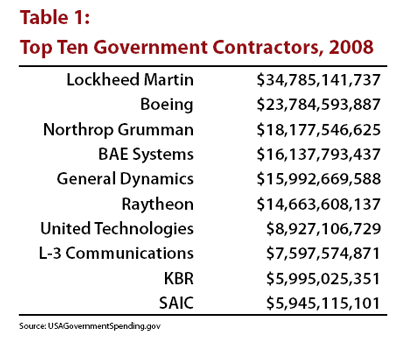
The living symbol of the new national security complex is Lockheed Martin, whose slogan is “We Never Forget Who We’re Working For.” That’s the U.S. government—sales to which account for more than 80% of the company’s revenues, with most of the balance coming from international weapons sales and other security contracts facilitated by Washington. In addition to its sales of military hardware, Lockheed is the government’s top provider of IT services and systems integration (see Table 1, below).
Whether it is military operations, interrogations, intelligence gathering, or homeland security, the country’s “national security” apparatus is largely in the same hands. Various components of the U.S. national-security state are divvied up among different federal bureaucracies. But increasingly, the main components are finding a common home within corporate America. Corporations such as Lockheed Martin, Boeing, L-3 Communications, and Northrop Grumman have the entire business—military, intelligence, and “homeland security”—covered.
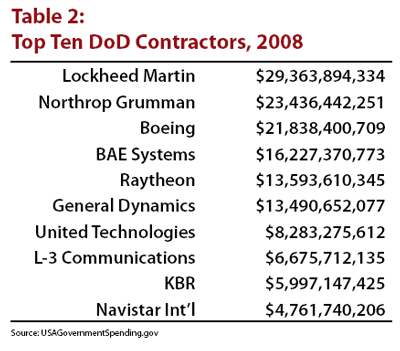
Lockheed Martin, Northrop Grumman, and Boeing led the top ten military contractors in 2008 (see Table 2).
The 2003 creation of the Department of Homeland Security has helped spawn an explosion of new companies, and new divisions of existing companies, providing “homeland security” products and services. Before President Bush created DHS in the wake of Sept. 11, the agencies that would be merged into the new department did very little outsourcing. From less than 1% of federal contracts (as a total dollar amount) in 2000, outsourcing by DHS has quadrupled as a portion of federal contracting from 2003 to 2009.
Top Ten U.S. Government Contractors, 2008
Although DHS contracts with scores of new companies, its top contractors are all leading military contractors that have established “homeland security” divisions and subsidiaries.
The top ten DHS contractors in 2008 were Lockheed Martin, Northrop Grumman, IBM, L-3 Communications, Unisys, SAIC, Boeing, Booz Allen Hamilton, General Electric, and Accenture, all leading military contractors. Other major military contractors among the top 25 DHS contractors include General Dynamics, Fluor, and Computer Sciences Corp (see Table 3).
Top Ten DoD Contractors, 2008
There is no public list of corporations that contract for U.S. intelligence agencies. But based on company press releases and filings with the Securities and Exchange Commission, Tim Shorrock concludes in his new book Spies for Hire that the top five intelligence contractors are probably Lockheed Martin, Northrop Grumman, SAIC, General Dynamics, and L-3 Communications. Other major contractors include Booz Allen Hamilton, CACI International, DRS Technologies, and ManTech International, also leading military contractors.
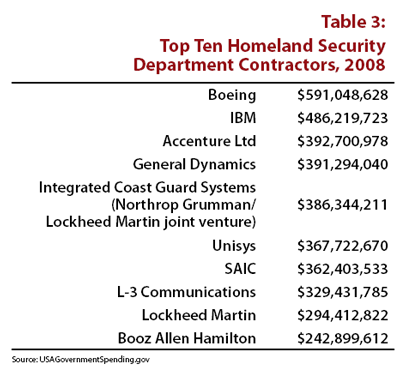
Top Ten Homeland Security Contractors, 2008
Within the past eight years—since Sept. 11, 2001—the intelligence budget has soared, rising from an estimated $30 billion in 2000 to an estimated $66.5 billion today. Intelligence agencies have channeled most of the new funding to private contractors, both major companies like CACI and thousands of individual contractors. Private contracts now account for about 70% of the intelligence budget. Intelligence community sources told the Washington Post that private contractors constituted “a significant majority” of analysts working at the new National Counterterroism Center, which provides the White House with terrorism intelligence.
The major military contractors are now moving their headquarters from their production centers, often in California and Texas, to the Washington Beltway in pursuit of more intelligence, military, and homeland security contracts. The gleaming Beltway office buildings of the security corporations are now the most visible symbol of this national security complex.

Boots on the Ground, Computers in Cubicles


Another feature of this evolving, ever-expanding complex is that all the U.S. government departments involved in national security—DoD, State Department, DHS, and intelligence—are outsourcing the boots-on-the-ground components of their missions through the use of private security and military provider firms. Companies such as ArmourGroup (which includes Wackhenhut), DynCorp, MPRI, and Xe (formerly Blackwater Worldwide) have injected the private sector directly into the public sector through their work as interrogators, military trainers, prison guards, intelligence agents, and war-fighters.
Five dozen of these security contractors have organized themselves into the International Peace Operations Association (IPOA). After Blackwater came under worldwide scrutiny for its massacre of unarmed Iraqis in central Baghdad on Sept. 17, 2007, the firm left IPOA, whose code of conduct for “peacekeeping” operations it had flagrantly ignored. Blackwater created a new association of private military contractors called Global Peace and Security Operations—conveniently without any potentially embarrassing code of conduct.
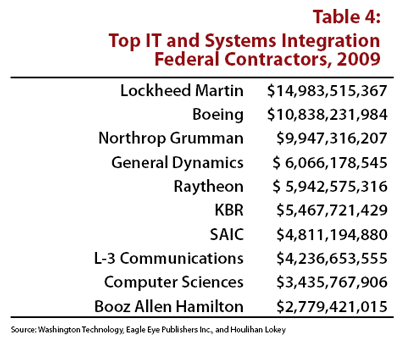
Top Ten IT and Systems Integration Federal Contractors, 2009
Private contractors are not only on the frontlines of war and clandestine operations, but have also penetrated the national security bureaucracy itself. Reacting to a March 2008 GAO report on conflicts of interest within the Pentagon, Frida Berrigan of the New America Foundation’s Arms and Security Initiative observed that alarming numbers of “cubicle mercenaries” are now working within federal bureaucracies as administrators, contract managers, intelligence analysts, and cybersecurity chiefs. No longer does the “large arms industry” that Eisenhower warned about just peddle goods like weapons and missiles, it also sells itself through its services.

Common Dominators of the New Complex: Information and Security


Private contractors are also in control of the core of the complex’s information and intelligence systems. Information and communications technology is the fastest-growing sector in government contracting. The DHS’s expanding involvement in cybersecurity, information systems, and electronic identification programs, for example, is adding billions of dollars annually to the national security boom.
Lockheed Martin led the ranks of information technology (IT) contractors in 2008, followed by Boeing and Northrop Grumman. Although IT contracts are expanding rapidly, there are few new entrants to the list of top IT providers to the government. Among the top 100 IT contractors, there were just twelve new entrants, as traditional military giants dominated the list (see Table 4).
One of the largest sources of federal contracting at DHS has been the EAGLE (Enterprise Acquisition Gateway for Leading Edge Solutions) IT program, which awarded $8.2 billion in contracts in the past three years. Among the leading contractors are CACI, Booz Allen Hamilton, Lockheed Martin, SAIC, Northrop Grumman, General Dynamics, and BAE Systems—all major military contractors. Most of the EAGLE IT bonanza is in the form of “indefinite-delivery, indefinite quantity contracts” that provide generous operating room for IT firms to determine their own solutions to DHS’ vast IT and cybersecurity requirements.
The major military corporations have quickly formed new branches to focus on these new opportunities outside of their traditional core contracts with the Pentagon. This year, for example, Northrop Grumman created a new Information Systems division to seek military, homeland security, and intelligence IT contracts. Recognizing the interest in the Obama administration in cyber-security and information war, corporations such as Booz Allen Hamilton and Hewlett-Packard, among others, have created new cybersecurity divisions or subsidiaries. Similarly, the new administration’s focus on transnational disease has led military companies such as General Dynamics to acquire medical subsidiaries.

Revolving-Door Security Consultants


Another manifestation of the new national security complex is the rise of a new series of consulting agencies that act as an interface between government and their clients. That’s an easy connection for such companies as the Chertoff Group, Ridge Global, and RiceHadley Group, since all their principals recently left government, where they had presided over the unprecedented wave of outsourcing.
Two of these national security agencies are headed by the DHS’s first two secretaries, Michael Chertoff and Tom Ridge, while the newest group brings together Condoleezza Rice and Stephen Hadley, who only a year ago were serving as secretary of state and national security adviser, respectively.
When announcing his group’s formation, Chertoff boasted, “Our principals have worked closely together for years, as leaders of the Department of Defense, the Department of Homeland Security, the Department of Justice, the National Security Agency and the CIA.” Indeed, a leading member of this new group is former CIA director Michael Hayden (2005-2009), who also directed the National Security Agency (1999-2005). Others include former DHS deputy Paul Schneider (who was head of acquisitions for NSA and the U.S. Navy prior to his position at DHS); Admiral Jay Cohen (Ret.), who was DHS director of science and technology and previously the Navy’s technology chief; and Charlie Allen, who was the intelligence chief at DHS and, according to Michael Chertoff, “pretty much head of everything you could be for the CIA.”
The Chertoff Group has now hooked up with Blue Star Capital, a transatlantic investment company specializing in mergers and acquisitions in the security business. In its announcement of the new partnership, Blue Star emphasized their joint interest in “generating opportunities” across the national security spectrum—“in the homeland security, defense, and intelligence markets.”
Chertoff himself applauded the value of the merger: “I believe there are many areas of opportunity within the Homeland Security, Intelligence and Defense sectors where the synergies between Blue Star and the Chertoff Group will provide real value.”

Taking Back Security


The “unwarranted influence” that concerned Eisenhower during the Cold War now pervades national politics and is rarely questioned. Nor has there been any evaluation of the achievements of the increasingly privatized national security complex. In his 2010 State of the Union address, President Obama talked about the need for fiscal restraint, but exempted “national security” from the planned spending freeze. Despite manifold evidence of vast waste and scandalous profiteering in the security apparatus—to say nothing of “unnecessary wars”—the president didn’t see fit to scale back the security agencies. By failing to do so, he has all but guaranteed that the outsourcing bonanza will continue. With “national security” off limits for budget cuts, Obama signaled that safeguarding the nation against the “unwarranted influence” and “rise of misplaced power” will not be priorities for this administration.
As major corporations such as Lockheed Martin and security consulting agencies such as the Chertoff Group extend their corporate tentacles into the intelligence, military, and homeland security terrains, the greater threat they pose. The corporate penetration of all the government’s information-gathering, communications, intelligence, and data systems undermines democratic governance. The new corporate domination of data-mining, communications, and cybersecurity systems—with little or no government oversight —threatens individual liberty and privacy. This also creates a powerful vested interest in a large and growing “national security” apparatus—and one that is deeply integrated with the top echelons of the intelligence agencies, military, and other parts of this secretive state-within-the-state.
In the end, it’s not the contractors that are the central problem with the national security complex—it’s the outsourcers, that is, the elected politicians and the government administrators they appoint or confirm. The contractors are working to maximize profits, and are answerable mainly to company shareholders. The outsourcers, however, are ultimately answerable, at least in principle, to the public. What is at stake is who really controls public policy—a democratically accountable government, or an unaccountable fusion of governmental and corporate power.
Tom Barry is a senior policy analyst and director of the TransBorder Project at the Center for International Policy in Washington, D.C. Barry is the author of numerous books on U.S. foreign policy, and he blogs on border security, immigration, and homeland security issues at borderlinesblog.blogspot.com.
Sources: Center for Defense Information, “Military Budgets 1946-2009,”; Center for Arms Control and NonProliferation, “2008-2009 U.S. Defense Spending Highest Since WWII,” Feb. 20, 2008; FedSpending.org, a project of OMB Watch; USASpending.gov; Tim Shorrock, New Spies for Hire: The Secret World of Intelligence Outsourcing, 2008; FY2009 Intelligence Budget, GlobalSecurity.org; F.J. Hillhouse, “Outsourcing Intelligence,” The Nation, July 24, 2007; Walter Pincus, “Lawmakers Want More Data on Contracting Out Intelligence,” Washington Post, May 7, 2006: David Horowitz, ed., Corporations and the Cold War, 1969; GAO, “Defense Contracting: Army Case Study Delineates Concerns with Use of Contractors as Contract Specialists,” March 2008; Frida Berrigan, “Military Industrial Complex 2.0,” TruthOut, Sept. 14, 2008; “2009 Top 100,” Washington Technology; DHS, Enterprise Solutions Office, EAGLE contracts; Global Homeland Security 2009-2019, VisionGain, June 23, 2009; Chertoff Group web pages, chertoffgroup.com; Homeland Security & Defense Business Council web pages, AntiWar.com, July 28, 2008; Allison Stanger, One Nation Under Contract: The Outsourcing of American Power and the Future of Foreign Policy (Yale University Press, 2009); Project on Government Oversight (POGO); Deborah Avant, The Market for Force: The Consequences of Privatizing Security(Cambridge University Press, 2005); Center for Public Integrity, “Making a Killing: The Business of War,” 2002, “The Shadow Pentagon,” 2004; Peter Singer, Corporate Warriors (Cornell University Press, 2003).

Friday, March 12, 2010

The Homeland Security Department Disaster


(This is the second in a series on the state of the Department of Homeland Security. The first part is at: http://borderlinesblog.blogspot.com/2010/02/americas-failing-homeland-security.html )

The Department of Homeland Security is a disaster.

Since its early days DHS has been an “area of risk,” according to the Government Accountability Office. Employee morale is abysmal, ranking among the worst of all federal agencies. Within DHS, private contractors outnumber federal employees. Seven years after its creation DHS is still grappling with a debilitating identity crisis.

DHS is a $55 billion department in search of a separate identity and a clear mission. A mash-up of 22 separate agencies, DHS continues to struggle to define itself – and to define exactly what is homeland security.

Since its beginning it has been the object of widespread criticism and frustration. Its signature feature – the color-coded terror advisory alerts – is commonly regarded as useless or even comical. DHS failed spectacularly its first big test in responding to Hurricane Katrina of August 2005, and the launch by DHS Secretary Michael Chertoff of its immigrant crackdown that same year has been widely derided as mean-spirited, ideologically driven, and largely disconnected from the post-9/11 national commitment to homeland security.

From the beginning DHS has been dogged by questions about its role with respect to DOD, FBI, and the CIA. Initially the U.S. public -- and even the department’s first secretary Tom Ridge – believed that the new department would consolidate and oversee the intelligence about threats to the U.S. homeland. Upon taking control of the new department, however, Ridge learned that DHS wouldn’t have a central role in homeland security-related intelligence but would be obligated to rely on the CIA, FBI, and DOD for threat assessments and most other intelligence.

The absence of a prime role in intelligence for the new Homeland Security Department highlighted the existential crisis at DHS. What is the vision, the mission, the essential justification for the creation and continued existence of this megabureaucracy of 220,000 employees?

The new department certainly has important governmental functions, such as border control, immigration policy enforcement, emergency management, transportation security, Coast Guard, and Secret Service. But since its creation DHS has been on a search for unifying identity. Apart from describing its parts, DHS hasn’t been able to say simply and clearly what it is as a whole.

One way DHS has faced this challenge is by simply declaring that it is a unified whole. In the introduction to One Team, One Mission, Securing Our Homeland: DHS Strategic Plan 2008-2013, Chertoff stated:

“We are a unified Department with a shared focus: strengthening our Nation – through a partnership with individual citizens, the private sector, state, local, and tribal governments, and our global partners. We must also coordinate across Federal agencies, while shaping homeland security policy and coordinating incident management.”
So what was that one mission for which this one team is responsible for?

The DHS mission, according to its strategic plan, is:
“We will lead the unified national effort to secure America. We will prevent and deter terrorist attacks and protect against and respond to threats and hazards to the Nation. We will secure our national borders while welcoming lawful immigrants, visitors, and trade.”
The DHS vision statement, animating this mission, is: “A secure America, a confident public, and a strong and resilient society and economy.”

A telling shortcoming  – one that has existed since the creation of DHS – is that DHS doesn’t have a leadership role in counterterrorism. In actual matters of homeland security, DHS is subservient to the same competing constellation of federal agencies – CIA, FBI, DOD, and NSA – that was responsible (along with the Bush White House) for the failures of communication and intelligence coordination that left the country open to the Sept. 11 attacks.

By the end of the Bush administration DHS had yet to establish, let alone demonstrate, that it was a leader in security, that it had a unified team, or that there was some important new role the department was playing moving the country toward its vision of a secure America, a confident society, and a resilient economy.

Its statements of leadership, purpose, and unity couldn’t gloss over what a mess the department was – evident even to the casual observer and documented by an embarrassing stream of critical reports from its own inspector general, the Government Accountability Office, and House oversight committees.

The Obama administration has done its best to shore up the credibility and integrity of DHS. The appointment of Janet Napolitano as the new DHS secretary went a long way to show that DHS would be moving beyond the ideological fervor, mean-spiritedness, and corporate coziness that characterized Chertoff’s tenure. Napolitano has ordered major reviews and overhauls within the vast bureaucracy, and she has proved to be smart, effective, and serious about her job.

With Napolitano at its helm and under a new administration, DHS has become a fixture in U.S. governance, passing from a start-up venture created in throes of the U.S 9/11 response to an increasingly consolidated institution in the DC firmament. Less dogmatic and more honest than her predecessor, Napolitano has made a “unified DHS” a goal rather than merely stating it as an accomplishment.

In implicit recognition of its problems, DHS now notes on its website:
“Six years on since the Department's creation, our goal is simple: one DHS, one enterprise, a shared vision, with integrated results-based operations. Through a consolidated headquarters, we are bringing 35 locations together. We are implementing a series of wide-ranging efficiency initiatives that leverage the economies of scale in our Department in order to recover hundreds of millions of dollars and create a culture of responsibility and fiscal discipline.”
But determination, better management, leadership skills, along with an improved team of top officials, won’t be enough to rescue DHS.

Dressing up immigration enforcement in new and less divisive language and eliminating some of the excesses of the previous administration haven’t altered the severity, tragedy, and divisiveness of the immigrant crackdown. The recent integration of the Homeland Security Council into the National Security Council, while appropriately recognizing that homeland security and national security overlap, also raises new questions about the defining duties of DHS.

It’s an immense new federal bureaucracy that has yet to explain what it is doing that its member agencies weren’t doing – or couldn’t have done -- before its creation. What’s the added value, if any, of our Department of Homeland Security?


Next: The Much-Vaunted Resiliency of the Homeland Security Enterprise

Thursday, March 11, 2010

National Magazine Award Nomination

Some personal news. That article I wrote for the Boston Review, "Death In Texas," has been nominated along with the magazine and its editors, Deb Chasman and Joshua Cohen, for a National Magazine Award in the Public Interest category.

Here's the link to the announcement: http://magazine.org/ASME/ABOUT_ASME/ASME_PRESS_RELEASES/nma-2010-finalists-list.aspx

This type of article is rare, mostly because there are few publications and editors that provide the kind of moral support and freedom to delve into a topic that the Boston Review did for me.

The Public Interest category certainly fits this piece, which is also just a small part -- in many ways a product -- of the inspiring public interest advocacy on these issues by such groups as Detention Watch Network, Grassroots Leadership, ACLU, and Justice Strategies.

I have a new article in the latest issue of another Boston-area publication, Dollars & Sense, that explores the evolution of the military-industrial complex. Here's a link to the magazine's table of contents: http://www.dollarsandsense.org/archives/2010/0310toc.html It's titled: Synergy in Security: Rise of the National Security Complex.

Concern about the uses and crimes of this complex is how many of us got involved in progressive politics. Most of those concerns remain, decade after decade, but what's so shocking and difficult to comprehend is why we accept, decade after decade, that billions, trillions of dollars are wasted in the name of national security. I will circulate the article here when there is an online version.


Saturday, February 27, 2010

Homeland Security's Mindless Drone Strategy


(The final article in a series on the turn to SBInet and UAVs for border security.)

Customs and Border Enforcement, the Homeland Security agency that includes the Border Patrol, claims that Unmanned Aerial Vehicles (UAVs) are a “force multiplier.”  


CBP has made the same assertion about ground-based remote surveillance systems, starting in the late 1990s with ISIS, continuing through the America’s Shield Initiative, and most recently with SBInet. has not, however, been able to support this claim.

General Atomics’ founder and CEO Thomas Cassidy makes the same force-multiplier boast. “The partnership between General Atomics and DHS/CBP has served as a force multiplier to the existing southwest border domain awareness capability, providing a dramatic increase in the ability of CBP to monitor our borders,” stated Cassidy in a press release announcing the second DHS Predator UAV contract.

A December 2005 report by DHS’ Office of Inspector General cast doubt on the Border Patrol’s force-multiplier argument for UAVs. Based on the experience with the Hermes and Hunter UAVs, OIG found that operating one UAV requires a crew of 20 support personnel, not counting the number of Border Patrol agents involved in tracking down UAV-supplied surveillance videotape in the field.

OIG also found that the cost of operating a UAV is “more than double the cost of manned aircraft.” Furthermore, the use of UAVs “has resulted in fewer seizures.”

The same December 2005 OIG report on remote surveillance also noted: “During interviews with Border Patrol officials at headquarters and in the sector offices, we were told that remote surveillance technology was a force multiplier. However, [the agency] could not provide any quantifiable data to support this claim.”

In addition, the DHS inspector general also observed that UAVs were less effective, in their limited tests, than manned aircraft in supporting the apprehension of unauthorized aliens. According to the OIG report, the Border Patrol tapped UAVs to assist in the apprehension of illegal immigrants who had already been detected by other means – creating new doubts about how the accuracy of Border Patrol statements that UAVs play a central role in immigrant arrests and marijuana seizures.

At the time OIG released this disturbing report contrasting Border Patrol claims about the value of high-tech instruments of border security with the reality of their shortcomings and high costs, the Department of Homeland Security was on the cusp of greatly expanding both its ground and air surveillance systems.

However, instead of slowing down the development of these programs or calling for a major reassessment of its high-tech surveillance programs, CBP has kept pushing ahead, buoyed by seemingly unlimited congressional and executive branch support for all its border security programs, whether cost-effective or not.

No Bottom Line for High-Tech Border Security

Concern about the costs of CBP’s push for UAVs has come from the Border Patrol Union. “Unmanned aircraft serve a very useful role in military combat situations, but are not economical or efficient in civilian law enforcement applications,” said T. J. Bonner, president of the union.

“There are a number of other technologies that are capable of providing a greater level of usefulness at a far lower cost,” Bonner said, “It appears that the contractors have once again managed to sell a bill of goods to the politicians and bureaucrats who oversee the procurement of technology designed to secure our borders.”

The advantages to the military of deploying armed UAVs – saving pilot lives in search-and-destroy missions in war zones – are manifest (albeit highly controversial). Less clear are the advantages of using unarmed UAVs for nontargeted information-gathering along the border.

CBP boasts of the speed and potential flying time of UAVs. But says nothing about their high cost, high accident rate, and fundamental dependence on industry and BP crews to interpret data and act on that data.

In contrast to a manned low-flying small planes and helicopters, whose pilot can quickly identify suspected illegal border crossers, a UAV needs a team on the ground to interpret data, thereby slowing the Border Patrol’s response.

Since 2004 CBP has been able to advance the UAV program – and SBInet-- in Congress, in DHS, and among the public largely because of its high-tech, cyber-is-great appeal. Underlying the program is an uncritical belief in possibilities of technology.

In the private sector and in most of government outside the national security apparatus, high-tech fixes like SBInet and the UAV program would likely come under more critical review because of its high cost. But when it comes to the government side of the national security complex, which taps the ever-rising budget authorizations for homeland security, there is no discernible bottom line – and therefore, apparently, no need for cost/benefit assessments.

The rush to bolster homeland security was understandable and politically popular in the wake of the Sept. 11 attacks. Yet more than eight years later the federal government and both political parties have been unable to focus on protecting the country against real and potential threats.

Trying to stand by its promise to gain “operational control” over the land borders, DHS has turned to high-tech fixes for border security. But its turn to technology – such as virtual fences and drones – reflects DHS’ now-endemic inability to mount focused border-security operations guided by risk assessments.  

With little or no in-house technological expertise and with seemingly unlimited funds, DHS has recklessly pursued border-security strategies that aren’t tied to threat evaluations. In its pursuit of high-tech solutions, DHS hasn’t been bound by the type of financial concerns that burden nonsecurity government agencies and most of the American people.

CBP Illustration of Border Security

With no foundation grants or institutional support, Tom Barry and the TransBorder Project of Center for International Policy count on individual financial support to continue this investigative, analytical, and advocacy work.

Go to the CIP online donation page, and write TransBorder Fellowship in comment section when making your donation. Or mail a check to CIP, noting this project. Thank you!

Friday, February 26, 2010

Border Drone Payload -- Marijuana at $70K a Pound, But Immigrants Come Cheaper


The Border Patrol points to the increasing number of arrests and amount of drugs seized as evidence of UAV benefits.

In promoting expanded UAV deployment, CBP has downplayed widely acknowledged concerns about UAVs such as their high failure rate and their limited access to U.S. airspace. Instead of assessing the appropriateness and effectiveness of its UAV program, CBP instead highlights how its aerial surveillance has contributed to stopping illegal border crossers and illegal drugs from entering the country – categorized broadly by DHS as “dangerous people and goods.”

The Predator – whose latest version is called the Reaper by the Pentagon -- has proved most valuable in search-and-destroy military missions rather than in intelligence missions (mainly because of the huge amount of nontargeted video that must be processed and reviewed). In its Unmanned Systems Integrated Roadmap, which projects potential UAV use over the next three decades, DOD says that the primary mission of the Reaper (latest version of Predator) – officially called MQ-9 --- is “to act as a persistent hunter-killer for critical time-sensitive targets and secondarily to act as an intelligence collection asset.”

However, Homeland Security uses Predators primarily for information gathering, not actually hunting. While their cameras do pick up the targets – mainly illegal border crossers – the UAVs can’t hunt them down. The images must be transferred by satellite to the command and control centers for processing by industry operators and Border Patrol agents.

Before the first Predator crashed, after 959 hours on patrol, it contributed to 1,793 arrests of illegal border crossers and the seizure of 200 pounds of marijuana.

As the number of Predators owned by CBP has increased and the UAV program has lengthened, those numbers have increased – rising to 3,900 arrests and 13,660 pounds of marijuana by March 2007 and by early 2009 more than 4,766 arrests and 22,823 pounds of marijuana. UAV flight time rose to nearly 2,000 hours by 2007 and more than 3,000 hours by 2009, according to the Border Patrol.

Per Unit Costs

At the price of $14 million, the UAV program cost U.S. taxpayers about $7,800 to catch each illegal border crosser.

(The $14 million figure is what DHS paid for its first Predator system. This price included a remote piloting team and other General Atomics support. But it does not include the costs of making the actual arrests and seizures, which includes the crews of Border Patrol agents, their vehicles, and often manned aircraft.)

Measured in terms of the confiscated marijuana, the UAV program cost U.S. taxpayers roughly $70,000 to help the Border Patrol seize each pound of the smuggled illegal drug.

Since 2005 the costs of the UAV program have steadily increased and the benefits have steadily decreased. The second CBP contract with General Atomics for two UAVs cost $34 million.

Despite having at least three more Predators deployed in the 2006-2008 period, the number of arrests and seizures aided by UAVs did not experience a corresponding rate of increase. Arrests doubled over the next three years, while seizures of marijuana increased about 175%.

In addition to the high cost of the arrests and seizures attributed to UAV assistance, what also stands out about CBP’s UAV program are two trends: 1) the only drug seized has been marijuana, and 2) the slow rate of increase in UAV operational time despite the higher number of UAVs.

CBP says it maintains a “risk-based” standard for its drug seizure operations. But in the case of the UAV program, the drones only aided Border Patrol agents seize the least harmful (indeed many medical and psychological experts assert that marijuana can  actually be beneficial when properly used) of illegal drugs.

Which makes sense, of course, since marijuana, being bulkier and also less valuable in the market, is routinely smuggled across the border by “mules” on foot, while more care and expense is generally given to smuggling heroin and cocaine using planes and vehicles legally crossing through ports of entry. (For more information on CBP’s “risk-based” drug seizures, see Immigrant Crackdown Joins Failed Wars on Crime and Drugs.)

During the lifespan of the first Predator at CBP, the drone flew nearly 1,000 hours, but with a fleet of at least three and as many as five drones over the next three years, flight time increased by only some  2,000 hours.


Unmanned Aerial Vehicles with Little Air

The slow pace of increasing UAV flight time is not unexpected.

DHS has been wishing and hoping that the mounting combined pressure from DOD, UAV industry, congressional UAV caucus, and Homeland Security itself would result in the opening of more public air space to UAV deployments at home. As it is, the DHS use of UAVs relies on military bases for their command centers, military airspaces along the border, and special arrangements between DOD, DHS, and the FAA for flights that penetrate national airspace.

DHS says it is working closely with DOD and the FAA to “remove current flight restrictions on Border Patrol Southwest border operations” and its use of national airspace. One possible solution being explored by DHS’ Science & Technology division is to install sense and avoid capabilities on UAVs that would automatically redirect UAV flights away from other air traffic.

Among its other objectives, the Congressional UAV Caucus is pressuring for “UAV-friendly laws” that would permit UAVs to be deployed freely in national airspace.
DOD has taken the lead in the drive to change FAA regulations to allow UAV use. A DOD directive on Sept. 26, 2006 encouraged military nonarmed UAV support domestically for homeland defense and defense support of civil authorities. The Pentagon’s determination to introduce greater UAV use for nonmilitary use at home is evident in its FY2009-Fy2034 Unmanned Systems Integrated Roadmap.

Until FAA, DOD, and DHS, and the UAV industry establish comprehensive guidelines for UAV use of national airspace, FAA and DOD are incrementally expanding UAV flight permission starting with the segregated airspace above military bases and extending to certain low-density airspaces such as the Arizona border. According to one assessment by a U.S. Army War College study, UAV are “increasingly ranging outside restricted military airspace as demand for a persistent airborne presence grows.”

Next: Mythical "Force Multiplier' of High-Tech Border Security

Thursday, February 25, 2010

Drone Lobby in Congress

Since the start of DHS’ drone program it has counted on the strong support of the increasingly influential Rep. Silvestre Reyes (D-Tex.), the El Paso area representative who came to Congress after working 26 years in the Border Patrol, retiring after building a national reputation as a border enforcer as district chief of the Border Patrol’s El Paso sector.


Reyes currently serves as chair of the House Select Intelligence Committee and is a member of the powerful Armed Services Committee. He is a prominent promoter of UAVs, which are tested and partly developed at the Ft. Bliss military complex in El Paso.


Reyes is a member of the little-known Congressional UAV Caucus, whose mission is to “educate members of Congress and the public on the strategic, tactical, and scientific value of UAVs, actively support further development and acquisition of more capable UAVs, and to more effectively engage the civilian aviation community on UAV use and safety.”


 Mission of Congressional UAV Caucus


The UAV Caucus says that its mission includes "actively support[ing] further development and acquisition of more capable UAVs" and "more effectively engag[ing] the civilian aviation community on UAV use and safety."

Members of the caucus state that they:
 
  1. Acknowledge the overwhelming value of UAVs to the defense, intelligence, homeland security, and the scientific communities;
     
  2. Recognize the urgent need to rapidly develop and deploy more UAVs in support of ongoing operations;
     
  3. Work with the military, industry, NASA, the Department of Homeland Security, the Federal Aviation Administration (FAA),  and other stakeholders to seek fair and equitable solutions to challenges created by UAV operations in the U.S. National Air Space (NAS);
     
  4. Support our world-class industrial base that engineers, develops, manufactures, and tests UAVs creating thousands of American jobs;
     
  5. Support policies and budgets that promote a larger, more robust national security UAV capability.


One business beneficiary of Reyes’ enthusiasm for drones is Aerospace Missions, a small company that after setting up in El Paso has received a steady stream of $1 million earmarks by Reyes from 2005 through 2009 to develop miniature sensors for UAVs.

As a member of the Air and Land Forces Subcommittee of the House Armed Services Committee, Reyes notes that the subcommittee is “responsible for funding key programs of importance” to Ft. Bliss and the nearby White Sands Missile Range and Holloman Air Force Base, including the Future Combat Systems, F-22 fighter aircraft, and Predator UAVs.

“As I serve on the House Armed Services Committee and the Intelligence Committee, I have been involved with the development of UAVs and know the importance of the intelligence they provide,” said Reyes in response to questions about his close relationship with Aerospace Missions and other UAV contractors.

UAV proponents, including UAV manufacturers and high-tech advocates within DHS, have not been above using the controversy over the border fence created by the Secure Border Fence Act of 2006 to promote UAVs for border security. This was a major theme at the 2008 Global Border Security Conference and Technology Expo in Austin.

Michael Rosenberg of E.J. Krause, the conference organizer, said: "Our goal is to bring together government and industry leaders to consider technology and policy strategies that move beyond the fence. The government's demand for advanced border technology is increasing and we are committed to providing a unique opportunity for government officials in homeland security and law enforcement to see first-hand what solutions are available to them.”

Another conference speaker was Rick Morgan of Aerospace Missions Corporation, the UAV development company surviving on congressional earmarks by Rep. Reyes and other members of Congress.

Congressional UAV proponents are not working alone. There’s a newly created industry association to parallel the UAV Caucus called the Unmanned Aerial Vehicles Systems Association (UAVSI), which has its own congressional advocacy committee and sponsors events. In close cooperation with members of the Congressional UAV Caucus, UAVSI sponsors an annual UAVSI Action Day on Capitol Hill, and congressional tours of UAV manufacturing facilities.

The principal market for UAVs is the military. Drone purchases accounted for more than one-third of the Air Force’s proposed 2010 aircraft budget. While the Predators have thus far been favored by DOD and DHS, other military contractors, notably Northrop Grumman and Lockheed Martin are seeking to makes more inroads into this booming market with its own UAVs.

Congress has passed a flurry of laws and budget authorizations to foster UAVs. Shortly after DHS was created Congress in 2003 directed DHS to study the feasibility of using UAVs, and has repeated this directive in numerous instances since then. The 2003 DOD Authorization Act (P.L. 108-136) required the president to issue a report “on the use of unmanned aerial vehicles for support of homeland security missions.”

As part of the 2007 appropriations bill Congress urged DHS to work with the FAA to implement a pilot program that would use UAVs for surveillance on the northern border.